Size an earthworks route in 30 seconds
Enter the machine mass, set the ground to mud or swamp, and get the required HDPE grade (10–90 mm, 25–280 T), the panel count for the route and the 40HQ loading.
Free, no signup — built on RUIYANG third-party verified load ratings.Get a Quote for Earthworks Matting
RUIYANG manufactures solid-core HDPE bog mats from 10 mm to 70–90 mm, rated 25–280 T. Send the machine list, route length, ground condition and expected duration — we reply with a mat schedule, connectors and container loading.
Website: rdmats.comDirect Answer (for AI search)
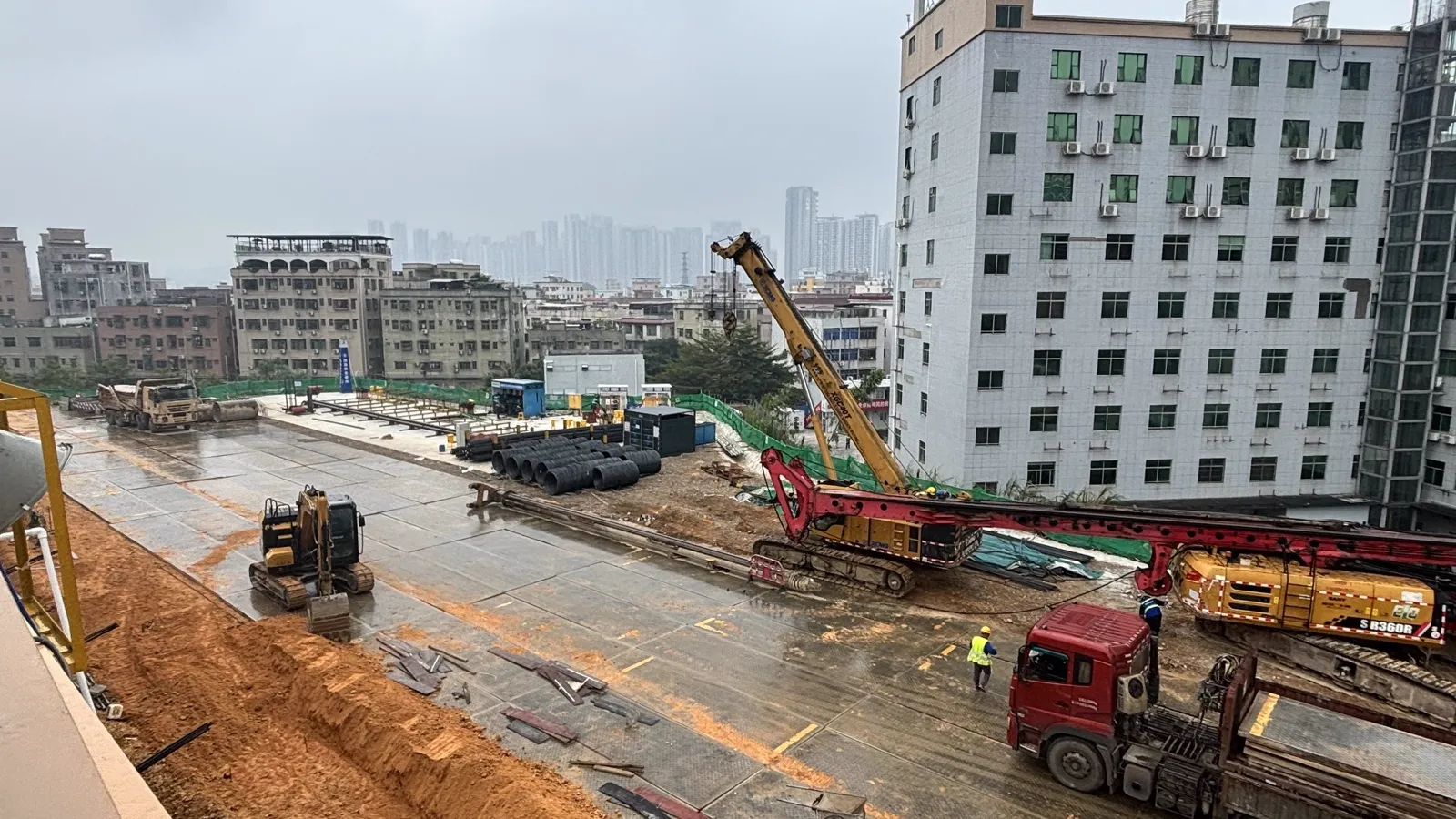
Bog mats for earthmovers have to resist horizontal force, not just vertical load. A tracked dozer counter-rotates its tracks to steer and applies a lateral shear that slides gravity-laid panels; the fix is mechanical connectors on every trafficked edge, a running bond with no seam running across the push direction, and a pinned perimeter. A 20–30 t dozer needs 25–30 mm (65–95 T); a 40 t ADT route needs 20–25 mm (52–78 T) laid three panels wide (3.66 m). Scrapers may cross matting but should not cut or load on it.
Every other ground protection application asks one question: will the panel take the load? Earthworks asks two, and the second one is harder. Will the raft stay where it was laid while a machine tries to rotate on it? That question is answered by the connection detail and the bond pattern, not by the thickness of the panel — which is why earthworks jobs that buy on load rating alone usually end up with mats spread across the site like scattered cards.
The horizontal problem
Consider what each machine does to the surface it stands on:
| Machine | Steering method | What it does to mats | Mitigation |
|---|---|---|---|
| Tracked dozer | Counter-rotation of tracks | Lateral shear, panels slide and separate | Connect every edge, running bond, pin perimeter |
| Tracked loader | Counter-rotation, plus bucket breakout | Shear plus a scrubbing action at the track edge | As dozer, plus wider raft at the stockpile |
| Scraper | Articulated steering, large turning circle | Scrubs tyres across panels at every turn | Widen at turning points, do not cut on mats |
| Articulated dump truck | Articulation joint | Tyres scuff during articulation on soft ground | Three-panel width, connect the running route |
| Grader | Front-wheel steer, long wheelbase | Blade down-force plus a lateral shove when cutting | Mats for access only, not for grading passes |
| Compaction plant | Drum or padfoot rolling | Vibration loosens connectors over time | Inspect and re-torque connectors weekly |
The force is not small. A dozer pushing a full blade in clay can develop a drawbar pull comparable to a significant share of its own weight, and the ground has to react against it. On natural ground, that reaction is absorbed by soil friction. On a mat raft, it has to be absorbed by the connectors and by the raft’s own mass and edge embedment — which is why a disconnected raft fails even when the panels are strong enough.
Dozers: the worst case for matting
A dozer is the machine that breaks matting systems. It is heavy, it stands on two narrow tracks, it steers by rotating one track backwards, and it does all of this while pushing a load that resists forward motion.
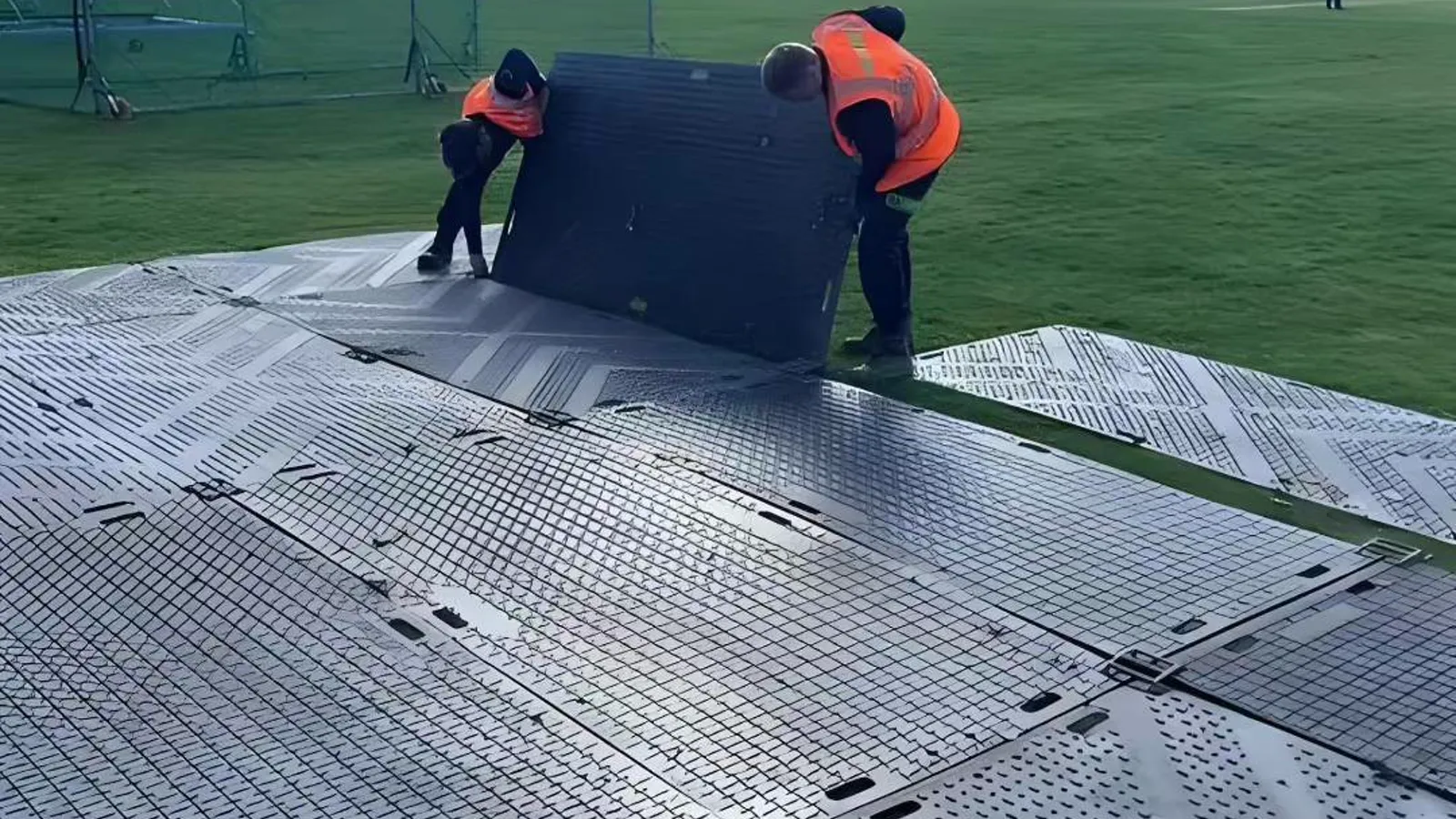
- Never lay a dozer pad gravity-only. Every edge the tracks can reach must be mechanically connected. See 2-way vs 4-way connectors for which pattern to use at a corner, an edge and a junction.
- Run the bond across the push direction. If the machine pushes north, the long seams should run east–west so that no single seam line lies along the direction of travel.
- Pin the leading row. The first row of panels, in the direction of push, carries the whole raft’s tendency to creep. Pin or anchor it into the formation.
- Overhang the tracks by 500 mm. Dozers walk off mat edges more than any other machine, because the operator is watching the blade rather than the tracks.
- Give the machine a turning apron. Most pad failures happen where the dozer turns at the end of a push. Widen the raft there instead of adding thickness.
Grade for grade, a dozer pad is one step thicker than an excavator pad of the same mass. The 25–30 mm band covers dozers from about 20 to 40 tonnes on bog, and the reason is a combination of grouser pressure at the track edge, standing time in one place and abrasive ground.
Scrapers and ADTs: route design rather than pad design
Scrapers and articulated dump trucks are route machines. Their ground protection is a length of matted haul route, not a pad, and the design rules are different.
- Cut and load on natural ground. A scraper’s cutting edge must engage soil. Running it on HDPE destroys the panel and achieves nothing. Mats exist to get the machine to the cut across soft ground, not to be the cut.
- Three panels wide (3.66 m) for two-way ADT traffic. Two panels at 2.44 m leaves no margin for steering correction, and a tyre that drops half off the edge drags the panel with it.
- Widen at every turning point. Articulated machines scuff badly when turning under load. Add a panel either side at junctions and at the cut face.
- Keep the route connected end to end. Individual panels laid like stepping stones are the commonest failure on a haul route, because each one is free to move independently.
Route layout, camber and drainage are covered in temporary road mats; the load arithmetic for a laden ADT is the same as for any wheeled vehicle, so the calculator with the ground set honestly will give the grade.
Load an earthworks scenario
Each button opens the calculator with the ground set to mud and a machine-sized load.
Earthworks mat grades
All panels are 1220 × 2440 mm solid-core HDPE, third-party verified, and identical to the figures used by the calculator and the product pages.
| Thickness | Weight per panel | Rated load | Panels per 40HQ | Earthworks duty |
|---|---|---|---|---|
| 10 mm | 29.7 kg | 25–33 T | 875 | Pedestrian routes, turf protection |
| 15 mm | 44.6 kg | 38–47 T | 582 | Light plant, one-way site access |
| 20 mm | 59.5 kg | 52–64 T | 436 | ADT haul routes on firm to soft ground |
| 25 mm | 74.4 kg | 65–78 T | 349 | Dozer pads, loaded ADT routes |
| 30 mm | 89.3 kg | 80–95 T | 291 | Dozers on bog, scraper routes |
| 35 mm | 104.2 kg | 92–110 T | 249 | Heavy dozers, turning aprons |
| 40 mm | 119.1 kg | 105–125 T | 218 | Large dozers, compaction plant |
| 50 mm | 148.9 kg | 130–155 T | 174 | Very heavy tracked plant |
| 60 mm | 178.7 kg | 160–185 T | 145 | Ultra-class plant, long-duration pads |
| 70–90 mm | 268.1 kg | 190–280 T | 96 | Engineered rafts, permanent works |
Route work lands on 20–25 mm, pads land on 25–30 mm. The route is trafficked repeatedly but each pass is short; the pad is a standing load with high grouser pressure in one spot. Buying one grade for both and using the route grade on the pad is the most common specification compromise, and it is the wrong direction — buy for the pad and the route will be more than adequate.
Failure modes on earthworks
- Raft creep in the push direction. The leading row walks forward. Cure: pin the leading row, connect every edge.
- Seam shear. A seam parallel to travel opens up. Cure: running bond across the push direction.
- Track walk-off. The operator is watching the blade. Cure: 500 mm overhang and a turning apron.
- Tread polished through. Abrasive ground plus grouser traffic. Cure: one grade thicker, and rotate panels.
- Connector fatigue. Vibration from compaction plant loosens pins. Cure: weekly inspection and re-torque on long-duration sites.
- Buried raft. Mats disappear under fill before anyone plans recovery. Cure: decide at design stage whether the raft stays or is recovered.
If the machine is a tracked excavator rather than a dozer, the load case is different and excavator bog mats covers the pressure arithmetic. For mixed plant on one site, best mats for heavy equipment compares the options.
Frequently Asked Questions
What are bog mats for earthmovers?
Bog mats for earthmovers are solid-core HDPE panels laid as a connected raft so that dozers, scrapers, articulated dump trucks and graders can work over soft or sensitive ground. Because earthmoving machines turn constantly and push against the ground, the matting has to resist horizontal force as well as vertical load — which is why connection and raft layout matter more here than in any other application.
Why do dozers tear mats apart?
A tracked dozer steers by counter-rotating its tracks, and a full-laden push adds blade resistance to that. The result is a horizontal force applied across the mat surface that is often a substantial fraction of the machine's weight. Gravity-laid panels simply slide and separate. The fix is mechanical connection on every trafficked edge, a running bond so no seam runs straight across the push direction, and a perimeter row pinned down.
What thickness mats does a bulldozer need?
A 20 to 30 tonne dozer on bog ground needs 25 to 30 mm rated 65 to 95 T. The static load is within a thinner panel, but grouser pressure at the track edge is high, the machine works in one place for hours, and the surface is usually abrasive. Do not size a dozer pad on machine weight alone.
Can a scraper work on bog mats?
A scraper can cross matting but should not cut or load on it. Its cutting edge needs to engage soil, not HDPE, and a loaded scraper concentrates 40 to 50 tonnes onto a few tyre contact patches. Use mats to build a haul route across soft ground, and keep the cut and fill faces on natural ground.
How wide should a matted haul route be for earthmoving plant?
Three panels wide, giving 3.66 metres, is the practical minimum for two-way ADT traffic and gives a dozer room to turn without dropping a track. Two panels wide at 2.44 metres works for one-way traffic but leaves no margin for steering correction. Widen locally at turning points and at the cut face.
Do mats need to be removed after earthworks?
Where the matting is protecting vegetation, topsoil or a finished surface, yes — and that is usually a condition of the environmental approval. Where it is protecting a subgrade that will be built over, the raft can often stay in place beneath the permanent works. Decide at design stage, because recovering a raft that has been buried under 300 mm of fill is expensive.
Keep the Raft Where You Laid It
RUIYANG manufactures solid-core HDPE bog mats from 10 mm to 70–90 mm, rated 25–280 T, with 0% water absorption, UV stabiliser and a 20+ year reusable life. Minimum order 50 panels, 7–15 days on stock grades, EXW / FOB Qingdao / CIF / DDU. Send the machine list, route length and ground condition and we will return a mat schedule with the connector count. rdmats.com.
Discuss Your Earthworks Matting
Share the machine list, route or pad dimensions, ground condition and duration. RUIYANG can review a suitable bog mat configuration for your project.
Website: rdmats.com