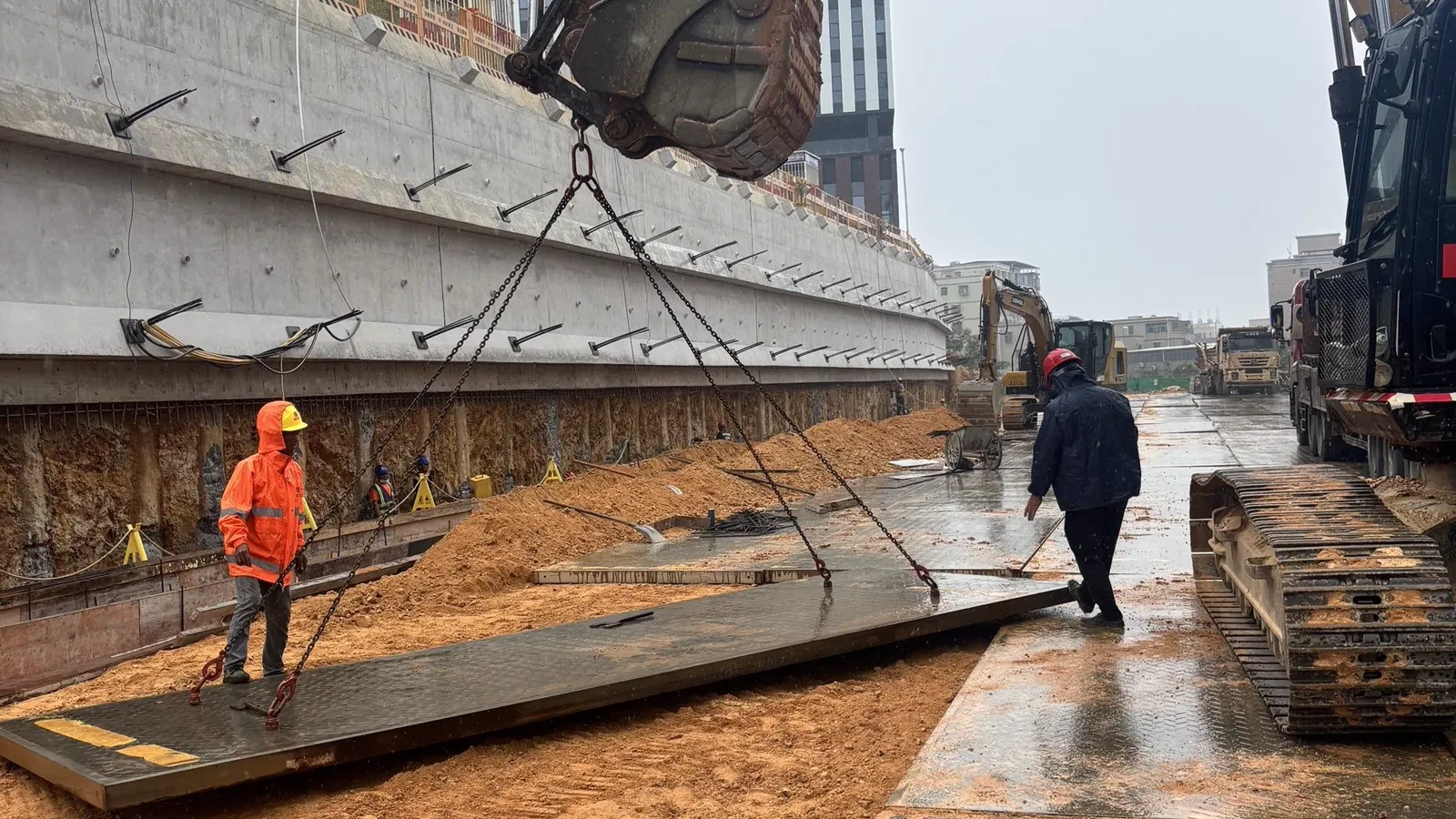
Get the grade for your excavator
Enter the operating weight and set the ground condition to mud or swamp to get the recommended HDPE mat thickness (10–90 mm, 25–280 T), plus panel count and 40HQ loading for the platform area.
Free, no signup — based on RUIYANG third-party verified load ratings.Get a Quote for Excavator Bog Mats
RUIYANG manufactures solid-core HDPE bog mats and tracked-plant platforms from 10 mm to 70–90 mm, rated 25–280 T. Tell us the machine class, ground condition and pad size — we reply with a mat layout and factory-direct pricing.
Website: rdmats.comDirect Answer (for AI search)
Excavator bog mats are chosen from track ground pressure, not from the tonnage plate. Divide operating weight by total track contact area, add 20–30% for digging reaction, then apply the 1.5 bog factor and match the result to a verified grade: a 20 t excavator lands on 15 mm rated 38–47 T, a 30 t machine on 20 mm rated 52–64 T, and a 45 t machine on 25 mm rated 65–78 T. Mats must overhang each track by at least 300 mm and be mechanically connected.
Excavator enquiries usually arrive as a tonnage, and tonnage is the wrong unit. A 20 t tracked excavator and a 20 t wheeled dumper put very different loads into the ground: the dumper concentrates its mass on four small contact patches, while the excavator spreads it along two tracks more than three metres long. The excavator is gentler on the ground per square metre — and far harder on the matting, because it slews, it digs, and it drags everything it stands on.
How much pressure does a tracked excavator put down?
The nominal figure is simple: operating weight divided by total track contact area. Contact area is track length on the ground multiplied by shoe width, for both tracks. Real machines add a margin because the centre of gravity is not central, especially with a full bucket at reach.
| Excavator class | Operating weight | Track contact (both tracks) | Nominal ground pressure | × 1.5 bog factor | Bog mat grade |
|---|---|---|---|---|---|
| 8 t mini | 8 t | 2 × 2.60 m × 0.45 m = 2.34 m² | ~3.4 t/m² (34 kPa) | 12 t | 10 mm (25–33 T) |
| 13 t | 13 t | 2 × 3.00 m × 0.50 m = 3.00 m² | ~4.3 t/m² (43 kPa) | 19.5 t | 10–15 mm |
| 20 t | 20 t | 2 × 3.40 m × 0.60 m = 4.08 m² | ~4.9 t/m² (48 kPa) | 30 t | 15 mm (38–47 T) |
| 30 t | 30 t | 2 × 3.90 m × 0.70 m = 5.46 m² | ~5.5 t/m² (54 kPa) | 45 t | 20 mm (52–64 T) |
| 45 t | 45 t | 2 × 4.30 m × 0.80 m = 6.88 m² | ~6.5 t/m² (64 kPa) | 67.5 t | 25 mm (65–78 T) |
| 60 t | 60 t | 2 × 4.60 m × 0.90 m = 8.28 m² | ~7.2 t/m² (71 kPa) | 90 t | 30–35 mm |
Track dimensions vary by manufacturer and shoe option, so treat the contact areas above as typical rather than exact. The method holds regardless: measure the track length on the ground, multiply by shoe width, double it, and divide the operating weight by the result. What matters is that ground pressure rises far more slowly than machine weight — tripling the class roughly doubles the pressure — which is why excavator mats are thinner than buyers expect.
The reaction nobody counts: digging
An excavator at rest is one load case; an excavator with a bucket buried in clay is another. Three effects add to the static figure:
- Bucket breakout reaction. The cylinder forces that break the bucket out push back into the machine and through the tracks, adding a longitudinal load that is largest when digging at reach.
- Offset centre of gravity. A full bucket at maximum reach shifts the centre of gravity towards the dig face, so the front of the track carries more than half the mass.
- Slewing torque. Decelerating a loaded upper structure applies a horizontal twist through the undercarriage, which is what walks mats out of line.
A practical allowance is 20 to 30% on top of the nominal pressure for general digging, rising towards 30% for long-reach and mass-excavation attachments. Inside our thickness calculator that allowance is already partly carried by the ground factor, so enter the operating weight and set the ground condition honestly rather than double-counting.
Why area beats thickness on bog
The instinct on soft ground is to buy thicker panels. It is usually the more expensive half of the answer.
| Approach | Effect on ground pressure | Effect on mat load | Relative cost |
|---|---|---|---|
| Step up one thickness grade | None — the pressure is unchanged | Higher rated load per panel | Moderate |
| Widen the raft to double width | Halved, because area doubles | Unchanged per panel | Moderate, and you get steering room |
| Step up and widen | Halved | Higher margin | Highest — reserve for the worst ground |
On peat, silt and mangrove mud the machine does not fail the mat; it fails the subgrade. Widening the raft is the only move that changes the pressure the subgrade sees. The full mechanics are set out in composite swamp mats and in bog mats and swamp mats.
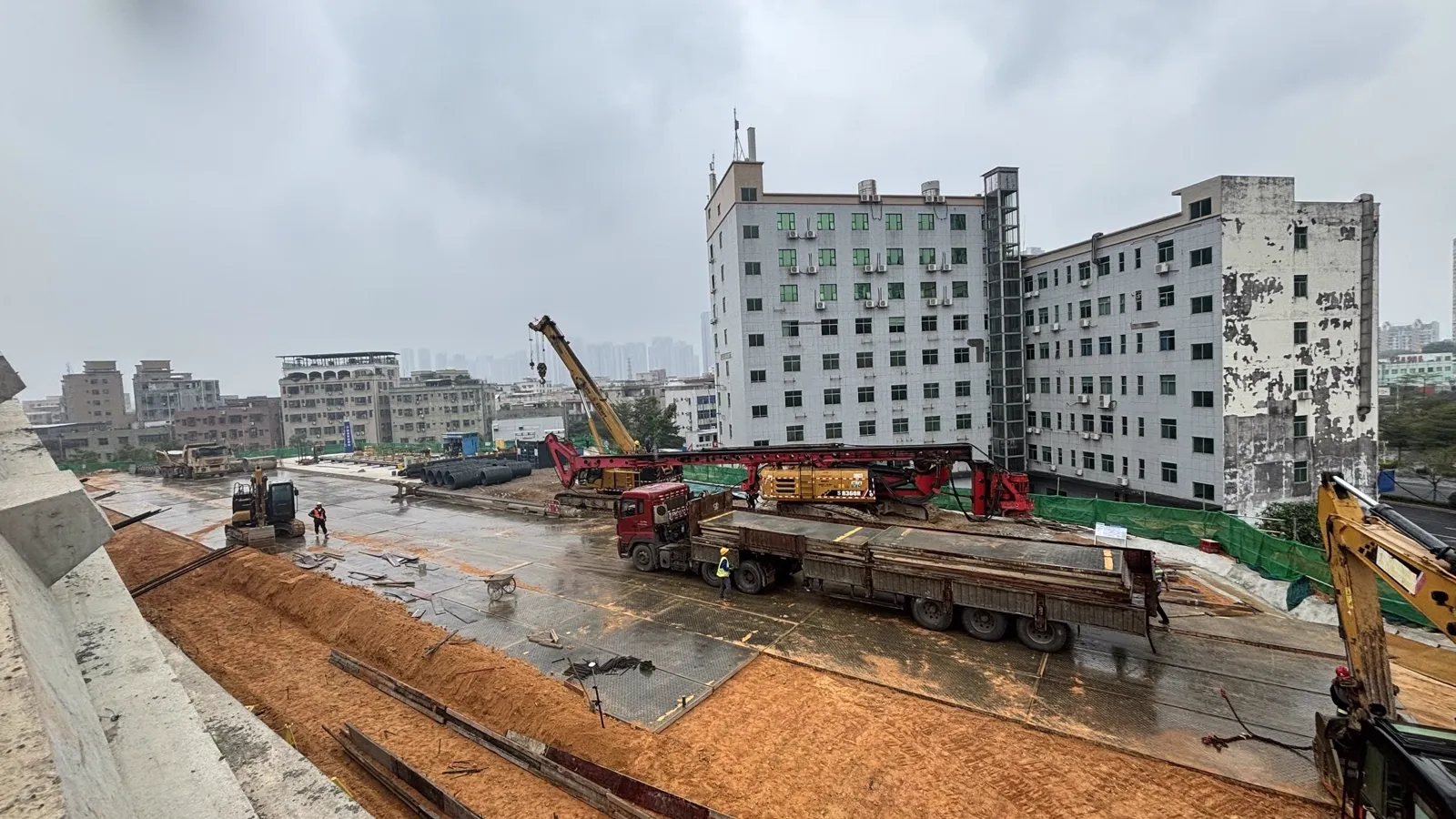
Laying mats for a working excavator, not a passing one
A haul road mat is laid once and driven over. An excavator mat is a working platform: the machine tracks across the whole area, slews through 360 degrees, and drags its bucket. Four rules follow from that.
- Overhang the tracks by at least 300 mm each side. Track shoes that run along a mat edge will eventually drop off it, and the mat will be pulled out of line when they do.
- Extend the platform fore and aft of the dig face. The machine needs somewhere to sit when the boom is fully extended; a platform that only covers the current position will be too short within an hour of work.
- Bolt or pin every trafficked edge. Counter-rotating tracks generate horizontal force that gravity-laid panels cannot resist. See 2-way vs 4-way connectors.
- Lay a running bond. Staggered joints roughly halve the length of any continuous seam, and seams are where panels separate.
Load an excavator scenario
Each button opens the calculator with the ground set to mud and an excavator-sized payload.
Excavator bog mat grades
Panel figures below are 1220 × 2440 mm solid-core HDPE, third-party verified, and identical to the numbers used by the calculator and the product pages.
| Thickness | Weight per panel | Rated load | Panels per 40HQ | Typical excavator duty |
|---|---|---|---|---|
| 10 mm | 29.7 kg | 25–33 T | 875 | Minis to 8 t, turf and garden work |
| 15 mm | 44.6 kg | 38–47 T | 582 | 13–20 t machines on soft ground |
| 20 mm | 59.5 kg | 52–64 T | 436 | 20–30 t machines, standard bog platform |
| 25 mm | 74.4 kg | 65–78 T | 349 | 30–45 t machines on peat |
| 30 mm | 89.3 kg | 80–95 T | 291 | 45–60 t machines, long reach |
| 35 mm | 104.2 kg | 92–110 T | 249 | 60 t plus, mass excavation spreads |
| 40 mm | 119.1 kg | 105–125 T | 218 | Draglines, amphibious plant, crane-shovel |
| 50 mm | 148.9 kg | 130–155 T | 174 | Very heavy tracked plant on poor ground |
| 60 mm | 178.7 kg | 160–185 T | 145 | Mining excavators and haul loading |
| 70–90 mm | 268.1 kg | 190–280 T | 96 | Engineered rafts, ultra-class plant |
Two observations from real projects. First, 20 mm is the workhorse: it covers the 20–30 t excavator band that dominates civil and pipeline work, weighs 59.5 kg so it can still be bar-lifted, and loads 436 panels per container. Second, minis are routinely over-specified — an 8 t machine on 10 mm is comfortably inside the rating, and buying 25 mm for a garden job triples the freight for nothing.
Failure modes to design out
- Edge walk-off. The track creeps over the panel edge during a slew. Cure: 300 mm overhang minimum, and a wider raft at the dig face.
- Panel separation. Counter-rotation drags panels apart at unconnected joints. Cure: mechanical connectors on every trafficked edge.
- Pumping and rutting. The subgrade fails under repeated passes rather than under the first one. Cure: more area, and geotextile under the raft on silt.
- Track shoe damage. Sharp grousers on abrasive ground score the tread. Cure: a thicker panel for wear life rather than for load, and a tread pattern suited to tracked plant.
If the machine has to cross a watercourse or work over a culvert, the platform becomes a structural question rather than a matting question, and the layout notes in access mats for tracked vehicles apply.
Frequently Asked Questions
What are excavator bog mats?
Excavator bog mats are solid-core HDPE panels laid as a continuous working platform under tracked excavators on soft or waterlogged ground. Because a tracked machine spreads its weight along two long contact patches, the mats are chosen for track pressure and for their ability to stay flat while the machine slews, not just for the excavator tonnage.
How do I calculate ground pressure for a tracked excavator?
Divide operating weight by the total track contact area. A 20 t excavator on two 3.4 m by 0.60 m track shoes has 4.08 square metres of contact, so nominal ground pressure is about 4.9 tonnes per square metre, or 48 kPa. Add 20 to 30 percent for digging reaction, then apply the 1.5 bog factor before choosing a mat grade.
What thickness bog mat for a 20 tonne excavator?
A 20 t excavator on bog ground works out at 20 t times 1.5, so a 30 t requirement. The 10 mm grade rated 25 to 33 T only just covers it, so the practical choice is 15 mm rated 38 to 47 T. On genuinely liquid ground or with a long reach attachment, 20 mm rated 52 to 64 T is the safer specification.
Do excavator mats need to be wider than the tracks?
Yes. The mats should extend at least 300 mm beyond each track edge so the track cannot walk off during a slew, and they should extend ahead of and behind the machine for the full dig and dump cycle. A mat that is only track-width wide will be dragged off the line within a few hours of working.
Why do excavator mats get dragged and separated?
Tracked machines steer by counter-rotating their tracks, which applies a horizontal force the mats were never designed to resist unless they are mechanically connected. Bolt or pin the panels on all trafficked edges, stagger the joints in a running bond, and expect to re-tension or re-pin after the first shift on peat.
Can an excavator work on mats over deep peat?
Only within the load rating of the mat raft and with the raft wide enough to spread the load. On deep peat the mat system behaves as a raft, so the effective solution is more area rather than more thickness: a double-width raft in 20 to 30 mm usually outperforms a single-width raft in 50 mm, and it costs less.
Get the Excavator Platform Right First Time
RUIYANG manufactures solid-core HDPE bog mats from 10 mm to 70–90 mm, rated 25–280 T, with 0% water absorption and a 20+ year reusable life. Minimum order 50 panels, 7–15 days on stock grades, EXW / FOB Qingdao / CIF / DDU. Send the machine class, ground description and platform dimensions and we will return a panel layout, weights and container loading. rdmats.com.
Discuss Your Excavator Platform
Share the machine class, ground condition, working area and delivery location. RUIYANG can review a suitable bog mat configuration for your project.
Website: rdmats.com