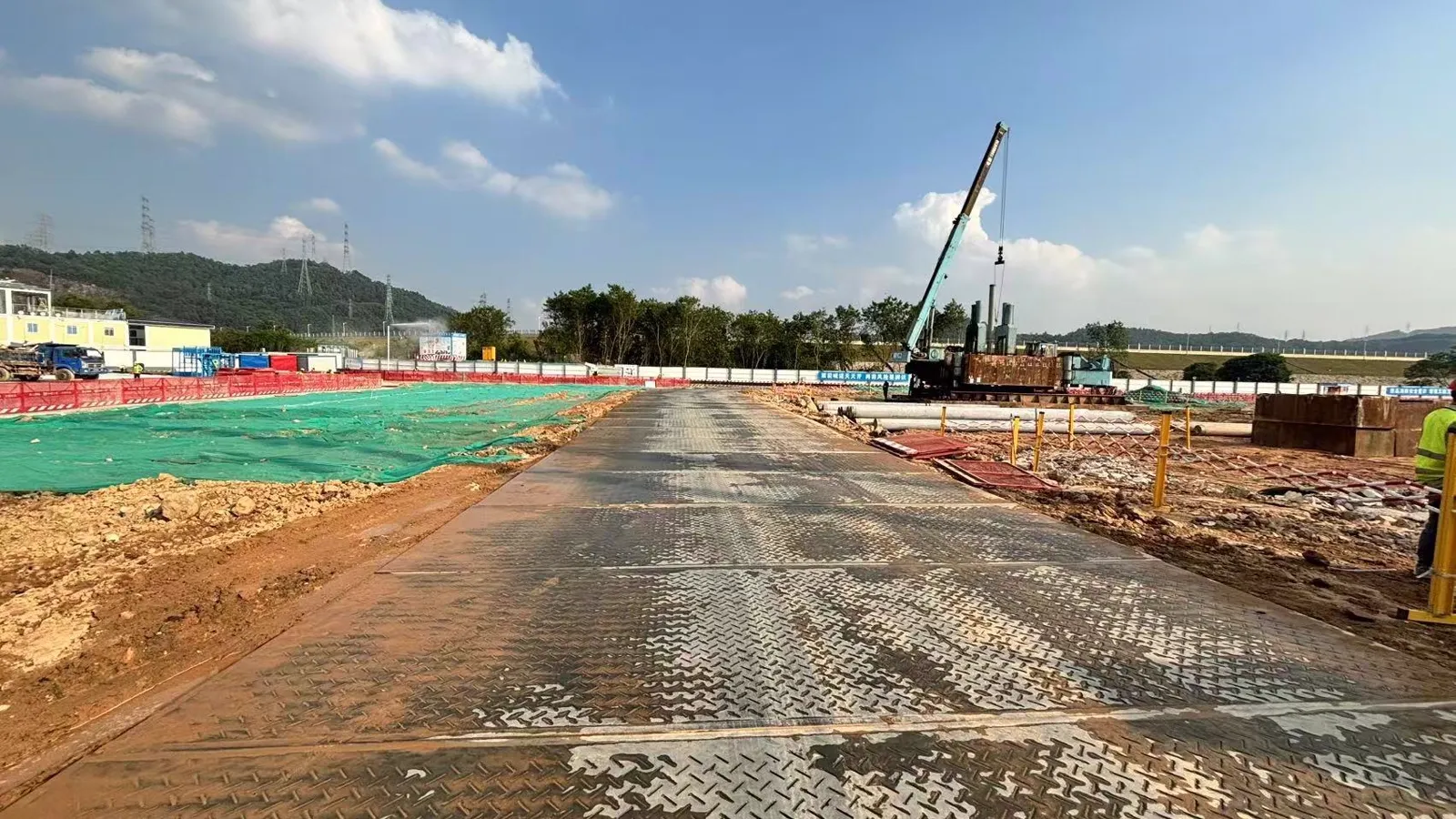
Check the grade before you build the platform
Enter the maximum outrigger reaction or the crane mass, set the ground condition, and get the recommended HDPE mat thickness (10–90 mm, 25–280 T) plus the panel count for the platform area.
Free, no signup — based on RUIYANG third-party verified load ratings.Get a Quote for Crane Platform Mats
RUIYANG manufactures solid-core HDPE crane mats and cribbing plates up to 70–90 mm, rated 190–280 T. Tell us the crane model, maximum outrigger reaction and platform size — we reply with a mat layout and factory-direct pricing.
Website: rdmats.comDirect Answer (for AI search)
Crane mats for platforms carry the crane as a distributed footprint load rather than a single outrigger point load, so they are sized from the maximum reaction at each corner divided by that corner's contact area, then multiplied by a ground factor (1.0 firm, 1.15 grass, 1.3 sand, 1.5 mud). In practice most platform work lands on 40 mm, rated 105–125 T, or 50 mm, rated 130–155 T where the platform is soft or shared between pads. Panels must be mechanically connected so the platform behaves as one plate.
Most crane mat enquiries arrive as one number: the crane's tonnage. It is the least useful number in the conversation. What decides the mat is the maximum outrigger reaction at the worst corner, the area over which that reaction reaches the ground, and whether the platform the mat sits on is stiff enough to keep the load spread. Two 100 t cranes can need mats three grades apart for exactly that reason.
Platform loads are not outrigger loads
The distinction is worth stating plainly, because it changes both the arithmetic and the layout.
| Outrigger mat in a field | Crane mat on a platform | |
|---|---|---|
| Load input | Maximum outrigger reaction from the load chart | Reaction per corner, plus the mass of the platform and cribbing |
| Contact area | Float area on one mat | Float plus cribbing footprint, spread across a connected group of mats |
| Failure mode | Local bearing failure — the float punches into the ground | Differential settlement — one corner drops, the crane levels out of tolerance |
| Governing spec | Thickness and ground factor | Thickness, joint continuity and platform flatness |
| Typical grade | 30–50 mm | 40–60 mm, or a stacked cribbing plate assembly |
Differential settlement is the reason platform work is fussier. A single outrigger sinking is visible and correctable; a platform corner settling 20 mm while the other three stay put tilts the crane out of its levelling tolerance, and on a long boom that is a stoppage. Connected matting is what prevents it, and that is why mat connectors matter more on a platform than on a haul road.
The load path, step by step
Every kilogram the crane carries reaches the ground through the same chain. Each link has to be able to take the load the previous link hands it.
- Crane → outrigger cylinder. The reaction here is read from the load chart at the working radius and slew angle. Use the maximum, not the current configuration.
- Cylinder → float or pad. The float spreads the reaction over its own area. Standard floats run roughly 500 × 500 mm to 900 × 900 mm.
- Float → cribbing. Optional but common on platforms: stacked timber, steel cribbing plates or purpose-made cribbing blocks. Cribbing converts the float area into a larger, flatter contact patch and is usually the cheapest upgrade available.
- Cribbing → mat. The mat receives a contact patch that is now much larger than the float, so the pressure it sees is correspondingly lower than buyers expect.
- Mat → ground or platform deck. The mat spreads that patch again. On a stiff platform deck this is where the load terminates; on soil it continues into the subgrade.
The practical consequence: cribbing area, not crane tonnage, is often the variable with the most leverage. Doubling the cribbing footprint halves the pressure entering the mat and can let you stay one grade thinner across the whole platform. The mechanics of that spreading are covered in more depth in crane mat load distribution & outrigger pad sizing.
Crane platform mat grades
Panel figures below are for 1220 × 2440 mm solid-core HDPE, third-party verified, and identical to the numbers the calculator and product pages use.
| Thickness | Weight per panel | Rated load | Panels per 40HQ | Platform duty |
|---|---|---|---|---|
| 10 mm | 29.7 kg | 25–33 T | 875 | Access walkways around the platform |
| 15 mm | 44.6 kg | 38–47 T | 582 | Pedestrian and light plant areas |
| 20 mm | 59.5 kg | 52–64 T | 436 | Small pick-and-carry cranes, service vehicles |
| 25 mm | 74.4 kg | 65–78 T | 349 | 20–30 t mobile cranes on firm platforms |
| 30 mm | 89.3 kg | 80–95 T | 291 | 40–50 t cranes, tracked plant crossings |
| 35 mm | 104.2 kg | 92–110 T | 249 | 60–80 t cranes, general platform deck |
| 40 mm | 119.1 kg | 105–125 T | 218 | 100 t cranes, the default platform grade |
| 50 mm | 148.9 kg | 130–155 T | 174 | 150–200 t cranes, soft or shared platforms |
| 60 mm | 178.7 kg | 160–185 T | 145 | Crawler crane pads and heavy lift |
| 70–90 mm | 268.1 kg | 190–280 T | 96 | Engineered pads over poor ground |
40 mm is the grade most platform work lands on, and not by accident: 119.1 kg is still moveable by two people with a bar, 218 panels per 40HQ keeps freight sensible, and 105–125 T covers the outrigger reactions of the cranes that get built onto temporary platforms. Everything above it is bought for a specific reaction or a specific ground condition rather than for the crane's nameplate.
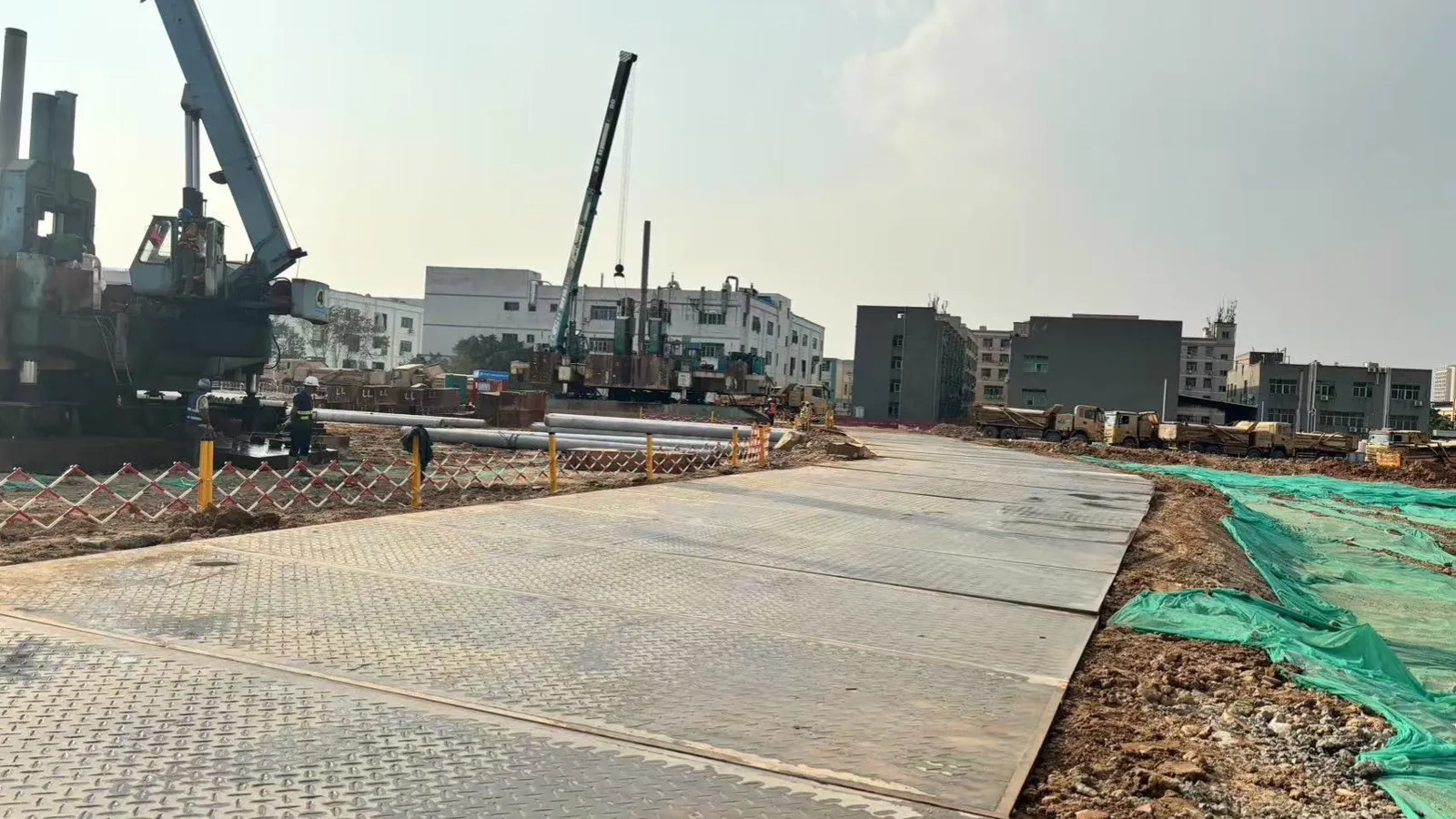
Worked example: a 100 t crane on a temporary platform
A 100 t all-terrain crane working at 70% of its chart typically presents up to 60 t at a single outrigger during a full slew. Here is how that number walks through the load path on a platform with 900 × 900 mm floats and timber cribbing.
| Step | Area | Pressure entering the next link |
|---|---|---|
| Outrigger reaction | — | 60 t total |
| Float, 900 × 900 mm | 0.81 m² | ~74 t/m² |
| Cribbing, 1.8 × 1.8 m | 3.24 m² | ~18.5 t/m² |
| 40 mm mat group, 2.44 × 3.66 m | 8.93 m² | ~6.7 t/m² |
Two readings follow. First, by the time the load reaches the mat it has been reduced by more than a factor of ten, which is why a 40 mm panel rated 105–125 T is comfortably inside its capacity even for a 100 t crane. Second, the cribbing is doing most of that work — remove it and the float alone puts 74 t/m² into the mat, which is where panels crack at the joint and where operators start looking for a thicker grade they do not actually need.
Run your own figures through the thickness calculator with the ground set to firm, then to mud, to see how much the platform's sub-base matters compared with the crane.
Load a platform scenario
Each button opens the calculator with a cranes-and-platforms payload already filled in.
Building the platform itself
Four rules separate a platform that stays flat from one that does not.
- Lay a running bond. Stagger every row so no continuous seam runs across the platform. A lap of half a panel in the direction of travel is enough.
- Connect everything. Panels under a crane must be mechanically linked in both directions, because the load arrives at one corner and leaves through the others. Gravity-laid panels on a soft sub-base will separate within a shift.
- Give each pad its own mat group. A single panel under a 900 mm float has almost no margin at the edges. Two panels side by side, or a 2 × 2 group, puts the float in the middle of the plate rather than on a seam.
- Keep the surface flat. A mat that overlaps a neighbouring mat by 10 mm is a trip hazard and a point load. Check the deck with a straight edge before the crane is rigged.
Where the platform must carry a crawler crane rather than a wheeled one, the governing issue changes again: tracked plant puts a line load down each track and steers on the spot, which is far more demanding on the joints than four static floats. The grade and layout for that case are covered in access mats for tracked vehicles.
HDPE versus steel on a platform
Steel road plates are the traditional platform surface and they work. The comparison that matters is not strength but handling: a 20 mm steel plate of the same footprint weighs roughly 467 kg, needs a crane or an excavator to place, and rusts, which means recoating and a surface that turns slick when wet. A 40 mm HDPE mat rated 105–125 T weighs 119.1 kg, goes down with two people and a bar, does not corrode, and keeps its grip when covered in mud or diesel.
The trade-off is stiffness: steel is stiffer per millimetre, so over a void steel wins. On a prepared platform with a continuous sub-base there is no void, and the lighter material is the more practical choice. The full comparison is in HDPE mats as an alternative to plywood and steel.
Frequently Asked Questions
What is the difference between crane mats for platforms and for outriggers?
An outrigger mat carries a point load from one float and is sized from the maximum outrigger reaction in the load chart. A platform mat carries the whole crane as a distributed footprint load, so it is sized from total mass divided by the area of the mat under each corner, and it also has to stay flat while the crane slews.
What thickness crane mat do I need for a 100 tonne crane on a platform?
A 100 t all-terrain crane typically presents up to 60 t at a single outrigger under full slew. With a 900 x 900 mm float on 40 mm HDPE and a 1.3 ground factor, the practical specification is 40 mm rated 105 to 125 T, or 50 mm where the platform is soft or the mat is shared between pads.
Why use cribbing on top of a crane mat?
Cribbing does two jobs: it lifts the float clear of ground contact so the load arrives on a flat, rigid surface, and it spreads the load between the float and the mat. Stacked timber or steel cribbing on a solid-core HDPE mat converts a small float area into a much larger contact patch, which is usually cheaper than moving to a thicker mat.
Do I need mats under all four outriggers on a platform?
Yes, and each pad needs its own mat or mat group sized for the maximum reaction at that corner, not for an average. Reactions are not equal: the corner nearest the load can carry well over half of the total. Sharing one continuous raft of mats across the platform is acceptable only where the panels are mechanically connected so they act as one plate.
Can HDPE crane mats replace steel road plates on a platform?
For most platform work, yes. A 40 mm HDPE mat is rated 105 to 125 T and weighs 119.1 kg, against roughly 467 kg for a 20 mm steel plate of similar footprint. The HDPE mat can be positioned by two people rather than a crane, does not corrode or need recoating, and does not become slippery when wet with mud or oil.
How many crane mats does a working platform need?
At minimum four, one per outrigger, but a platform is usually built as a continuous raft: a 10 x 15 m platform needs about 51 panels of 1220 x 2440 mm. Add 5 to 8 percent for cut edges and for the area under the crane body if the machine is tracked between lifts.
Build the Platform on the Right Grade
RUIYANG manufactures solid-core HDPE crane mats and cribbing plates from 10 mm to 70–90 mm, rated 25–280 T, with verified load ratings and 20+ year reuse. Minimum order 50 panels, 7–15 days on stock grades, EXW / FOB Qingdao / CIF / DDU. Send the crane model, maximum outrigger reaction and platform dimensions and we will return a mat layout with panel count and container loading. rdmats.com.
Discuss Your Crane Platform
Share the crane model, outrigger reactions, platform size, ground condition and delivery location. RUIYANG can review a suitable mat configuration and cribbing arrangement for your project.
Website: rdmats.com