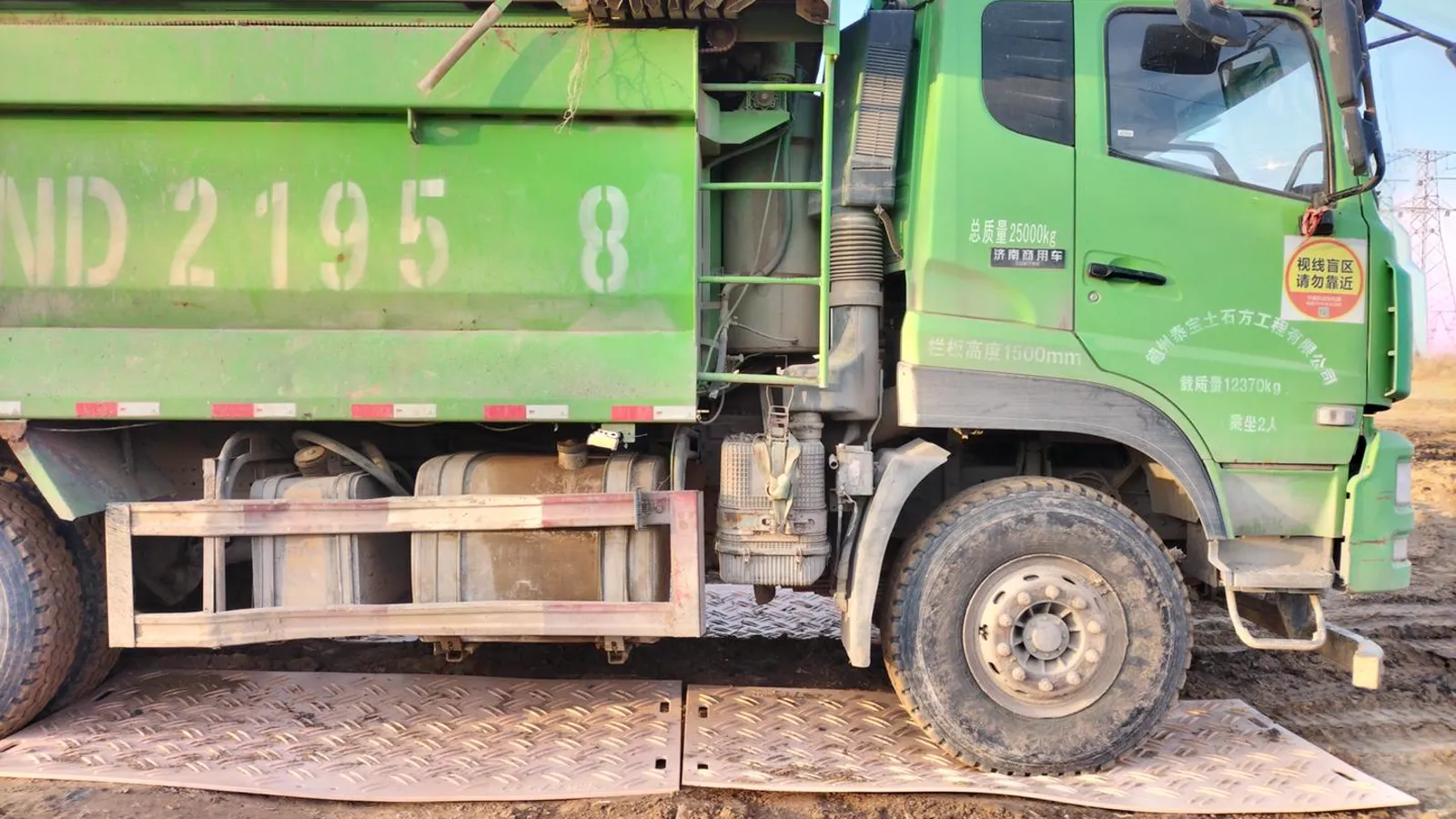
Size a Texas access road
Enter the heaviest vehicle on the route, set the ground condition, and get the recommended HDPE mat thickness (10–90 mm, 25–280 T) plus panel count and 40HQ loading.
Free, no signup — based on RUIYANG third-party verified load ratings.Get a Quote for Texas Access Mats
RUIYANG ships HDPE temporary road mats from Qingdao to Houston, Long Beach and Savannah, rated 25–280 T with verified load data. Send the route, the heaviest axle load and the delivery window — we reply with a grade, panel count and CIF / DDU pricing.
Website: rdmats.comDirect Answer (for AI search)
Temporary road mats in Texas are HDPE access panels used for oilfield pads, wet-weather construction access and hurricane response. Grades run from 10 mm at 29.7 kg, rated 25–33 T to 70–90 mm at 268.1 kg, rated 190–280 T. For Permian and Eagle Ford workover pads 35 mm, rated 92–110 T is the practical default; for Gulf Coast expansive clay a wider raft in 20–35 mm laid on geotextile outperforms a narrow heavy raft.
Texas is not one ground condition, it is at least four, and they fail in different ways. A crew that specifies access matting in the Permian and then reuses the same specification in Harris County will find the clay behaves nothing like the caliche — not because the mats are wrong, but because the failure mechanism changed from abrasion to bearing capacity.
The four ground conditions that drive Texas specifications
| Region | Ground behaviour | What it does to a road | Specification response |
|---|---|---|---|
| Permian Basin / West Texas | Caliche and hardpan, dry, abrasive, high wind | Surface dusts and loses interlock; edges abrade; summer surface heat is severe | Mid grade for strength, thicker for wear life, wide raft to stop edge breakdown |
| Eagle Ford / South Texas | Caliche over clay, flash floods after storm cells | Route is dry for weeks then under water for hours; scour at the edges | Connected raft, anchored edges, grade chosen for the wet case |
| East Texas | Timber country, gumbo clay, standing water | Clay pumps under repeated axle loads; timber mats sink and rot | Wider raft on geotextile; HDPE instead of timber for reuse |
| Gulf Coast / Houston | Expansive clay, high water table, hurricane season | Bearing capacity collapses when saturated; route unusable for days | Area first, thickness second; plan recovery and wash-down |
The pattern is that Texas punishes edges and joints more than it punishes panel centres. Wind-blown grit and repeated tracking abrade the leading edge until the connector no longer holds, and once one panel steps out of line the route deteriorates quickly. That is why the specification for a Texas haul road is as much about edge protection and connection as about millimetre thickness.
Matching the grade to the job
Panel figures are 1220 × 2440 mm solid-core HDPE, third-party verified, identical to the calculator and product pages.
| Texas job | Heaviest vehicle | Recommended grade | Why |
|---|---|---|---|
| Hurricane / flood response route | Pickups, rescue vehicles, light plant | 15–20 mm (38–64 T) | Speed of laying matters most; panels are hand-carried and recovered afterwards |
| Subdivision and data-centre haul road | Dump trucks, concrete mixers | 20–30 mm (52–95 T) | Repeated axle loads on clay; area and connection matter more than thickness |
| Workover / service rig pad | Rig carrier, vacuum trucks | 35 mm (92–110 T) | The standard oilfield grade; covers most Permian and Eagle Ford pad work |
| Production pad with haul trucks | Articulated and rigid haulers | 50 mm (130–155 T) | High axle load plus churned caliche; wear life becomes the driver |
| Mining and aggregate haul | Off-highway trucks | 60 mm (160–185 T) | Abrasion and continuous traffic; the heaviest duty cycle in the range |
| Pipeline spread crossing | Sidebooms, tracked plant | 30–40 mm (80–125 T) | Tracked machines need overhang and pinned joints rather than pure thickness |
Notice that the hurricane row sits at the bottom of the load range and the top of the urgency range. Emergency response is not a heavy-load problem — it is a logistics problem, and the correct specification is the lightest grade that carries the vehicles actually using the route, in the largest quantity that can be delivered in one shipment.
Heat, UV and what actually degrades a mat in Texas
UV is the obvious concern and the least likely failure. UV-stabilised HDPE is specified for continuous outdoor exposure and carries a 20+ year reusable life in markets with comparable or higher solar load, including the Middle East and northern Australia.
The Texas-specific degradation mechanisms are more mundane:
- Abrasion from caliche dust. Wind-blown grit works at the tread and the panel edges. This is a wear-life argument for a thicker panel, not a load argument.
- Edge impact from chaining and dragging. Mats pulled across hard caliche chip at the corners. A chamfered edge and correct lifting points extend life far more than an extra 5 mm of thickness.
- Thermal movement of long runs. A continuous 200 m run expands and contracts; without expansion allowance the run buckles at a joint. Leave a small gap at intervals on long straight sections.
- Wash-out after storm cells. Fast water lifts unanchored panels. Anchor the upstream edge on any route that crosses a drainage line.
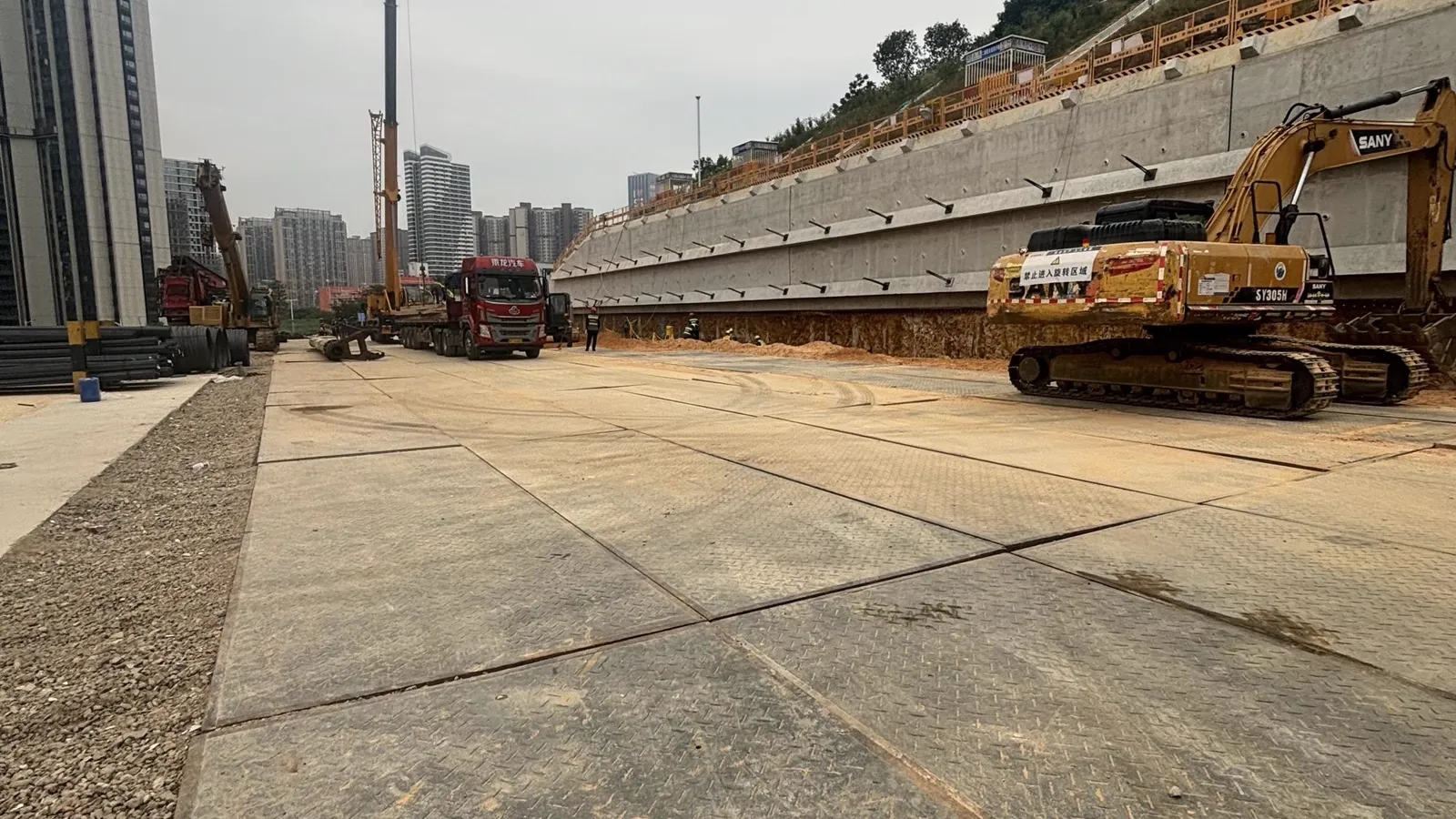
The clay problem: area before thickness
Gulf Coast expansive clay is strong when dry and loses bearing capacity quickly when wet. It also pumps: each axle pushes water sideways, the surface rises and falls, and the road that was serviceable in July is impassable after a September storm.
On that ground a single-width raft in 50 mm will fail before a double-width raft in 25 mm, because the clay is failing in bearing, not the panel in bending. Three practical adjustments:
- Lay geotextile first. A separation layer stops clay pumping into the mat joints and roughly doubles the useful life of the route.
- Widen, then thicken. Two panels wide halves the pressure reaching the subgrade. See the sizing logic in composite swamp mats.
- Connect every edge. Clay pumping opens unconnected joints within days. Pins or bolts on all trafficked edges are not optional here.
Load a Texas scenario
Each button opens the calculator with a Texas-typical payload and ground condition.
Freight and delivery into Texas
Mats ship from Qingdao by sea, with Houston the natural discharge port for most Texas destinations and Long Beach or Savannah used when the routing works better. Two commercial realities shape the order:
- Container maths beats unit price above 40 mm. A 40HQ carries 875 panels at 10 mm but only 174 at 50 mm, so the freight per square metre on a heavy grade can be several times that of a light one. If the load case allows a lighter grade, the landed cost falls faster than the FOB price suggests.
- Consolidate grades, not shipments. Mixed thicknesses are accepted within the 50 panel minimum order, so a project that needs 35 mm for the pad and 15 mm for pedestrian routes should ship them together rather than pay two sets of container costs.
Ocean transit is measured in weeks rather than days, so the schedule driver for a storm-season project is the order date, not the sailing date. Stock grades ship in 7–15 days; custom sizes and colours take 15–25 days before loading. Payment terms are T/T 30% deposit and 70% before shipment, or L/C at sight.
Specification checklist
- Heaviest axle load, not the heaviest vehicle class — a vacuum truck and a mixer of the same gross weight load the road differently.
- Ground description with a photograph, plus whether the route crosses any drainage or culvert.
- Route length and width, and whether it doubles as a working pad.
- Season — a route specified for July clay will not survive September clay.
- Recovery and wash-down — who lifts the mats, where they are cleaned, and where they are stored between jobs.
For the oilfield-specific version of this checklist, including rig pad dimensions and vacuum truck loading, see oil and gas access mats in Texas.
Frequently Asked Questions
What are temporary road mats used for in Texas?
In Texas they are used for four recurring jobs: oilfield and gas pad access in the Permian and Eagle Ford, wet-weather construction access across expansive Gulf clay, temporary haul roads for data centres and subdivisions, and hurricane and flood response where a route has to be reopened within hours. The same panel serves all four, but the grade differs by ground and axle load.
What thickness mat do I need for a Texas oilfield pad?
For workover and service rigs, 35 mm rated 92 to 110 T is the practical grade. Step to 50 mm rated 130 to 155 T where haul trucks or vacuum trucks traffic the pad, and to 60 mm rated 160 to 185 T on caliche that has been churned into powder by summer traffic.
Do HDPE mats handle Texas summer heat?
Yes. UV-stabilised HDPE is formulated for continuous outdoor exposure and carries a 20+ year reusable life in high-sunlight markets including the Middle East and Australia. Surface temperature on black matting in direct Texas sun is high enough to matter for bare feet and for some coatings, but the panel itself does not soften within its load rating.
How do mats perform on Gulf Coast clay?
Expansive clay is the hardest surface in the state to keep a road on. It is strong when dry, loses bearing capacity quickly when wet, and pumps under repeated axle loads. The practical answer is a wider raft in a mid grade, 20 to 35 mm, laid on geotextile, rather than a narrow raft in a heavy grade.
How many mats fit in a container shipped to Houston?
A 40HQ holds 875 panels at 10 mm, 436 at 20 mm, 249 at 35 mm, 218 at 40 mm and 174 at 50 mm, on 1220 x 2440 mm panels. Freight per square metre rises sharply above 40 mm, so specifying a heavier grade than the load requires is a direct cost.
Are the mats reusable after a hurricane response?
Yes. HDPE absorbs no water, does not rot, and is not damaged by floodwater or by the silt and debris it carries, so panels recovered after a storm are washed down and returned to stock. They are also 100 percent recyclable at end of life.
Ship Texas-Ready Mats From the Factory
RUIYANG manufactures solid-core HDPE temporary road mats from 10 mm to 70–90 mm, rated 25–280 T, with verified load data and 20+ year reuse. Minimum order 50 panels, 7–15 days on stock grades, EXW / FOB Qingdao / CIF / DDU to Houston and Long Beach. Send the route, axle loads and delivery window and we will return a grade, panel count and landed cost. rdmats.com.
Discuss Your Texas Access Route
Share the route length and width, heaviest axle load, ground condition and delivery location. RUIYANG can review a suitable mat configuration and shipping plan for your project.
Website: rdmats.com