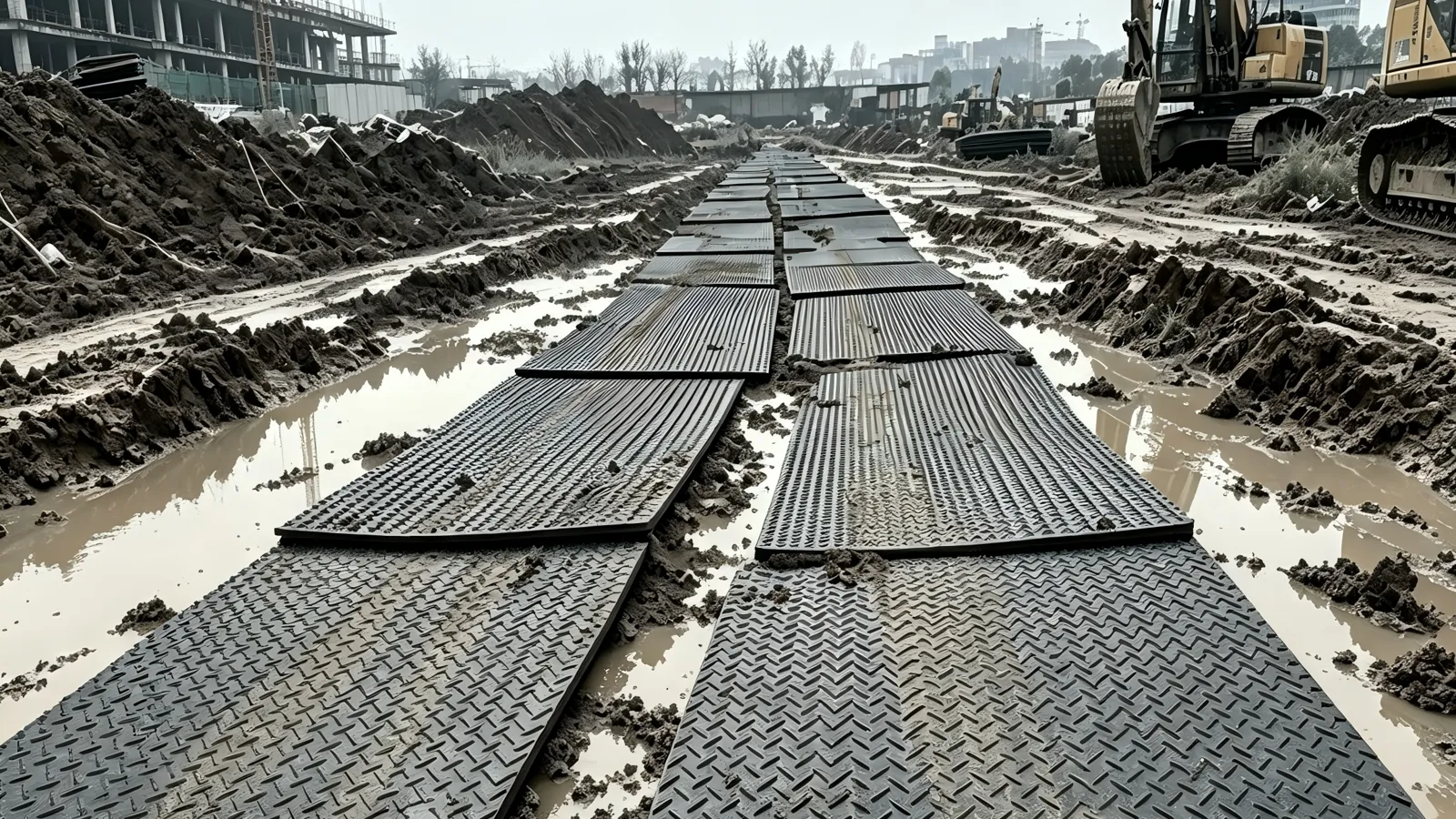
Size a mine site pad
Enter the equipment mass, set the ground to mud or swamp, and get the required HDPE grade (10–90 mm, 25–280 T), the panel count for the pad area and the 40HQ loading.
Free, no signup — built on RUIYANG third-party verified load ratings.Get a Quote for Mining Mats
RUIYANG manufactures solid-core HDPE bog mats from 10 mm to 70–90 mm, rated 25–280 T. Send the equipment list, ground condition and pad layout — we reply with a mat schedule, weights and container loading.
Website: rdmats.comDirect Answer (for AI search)
Mining bog mats go under stationary and slow-moving plant — blast-hole drill pads, mobile crushers, conveyors, pumps and laydown areas — not under haul trucks, which use formed haul roads. On a mine the governing case is usually abrasion, not tonnage: broken rock wears a panel faster than load deforms it. Specify 25–30 mm (65–95 T) for drill pads and 35–40 mm (92–125 T) under crushing plant, keep 20 mm for clean short-duration work, and rotate worn panels out of high-traffic positions.
Ask a mine planner what they need mats for and the answer is often “the haul trucks” — which is the one application where HDPE is the wrong answer. A 240 t haul truck needs a road, not a panel. What a mine actually buys mats for is the long list of equipment that has to work over ground nobody bothered to form: the drill pad at the top of a bench, the crusher that follows the face, the pump at the sump, the laydown where the tyres get changed.
Why mine sites break mats differently
On a civil site, mats fail because the ground is soft. On a mine, mats fail because the working surface is abrasive and the loads repeat. Three mechanisms dominate:
- Three-body abrasion. Broken rock and grit trapped between a track shoe and the panel act like grinding paste. A grouser on abrasive ground removes material from the tread on every pass.
- Impact from falling rock. Under a crusher discharge or a conveyor transfer point, rock falls from height onto the panel. HDPE absorbs impact well, but a 20 mm sheet under repeated impact from 200 mm rock will crack before it deforms.
- Point loads from chassis and skids. A mobile plant resting on four steel skids concentrates load into small areas, and those areas do not always line up with panel centres.
All three argue for thickness. Note that this is the opposite conclusion to the one on a bog — where area beats thickness. On a mine, the ground is often sound and the wear is at the surface, so thickness buys service life rather than bearing capacity.
| Mine application | Equipment | Governing issue | Grade |
|---|---|---|---|
| Blast-hole drill pad | Crawler rig, 30–50 t | Abrasion under tracks, level for hole angle | 25–30 mm |
| Mobile crushing / screening | Jaw or cone plant on skids, 40–60 t | Point loads at skids, impact from falling rock | 35–40 mm |
| Conveyor and pump stations | Static, moderate load | Long service life, UV exposure | 30–35 mm |
| Sump and tailings access | Excavator, light vehicle | Very soft ground, saturated subgrade | 25–30 mm, wide raft |
| Laydown and workshop apron | Forklift, tyre handler, cranes | Trafficking, oil spillage, point loads | 25–30 mm |
| Haul road (unsealed) | Rigid and articulated dump trucks | Not a matting application | Use formed road |
The drill pad: level is the specification
A blast-hole rig has to hold a hole angle, and on a benched pit that angle is surveyed. A pad that settles differentially under one track changes the angle between holes, which shows up as toe or crest problems at the next blast.
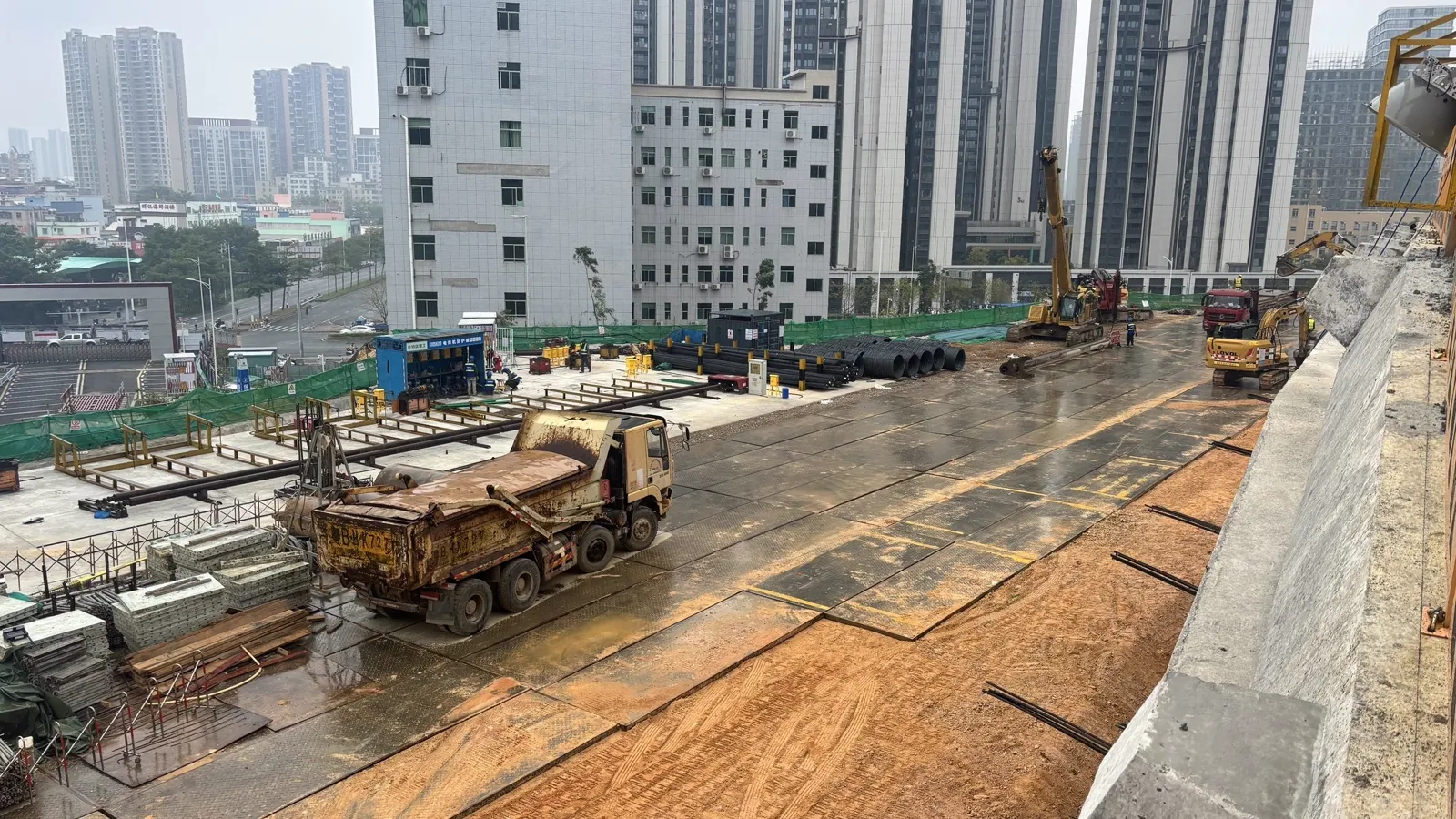
The pad sequence is the same as for any rig: strip, blind to one plane, lay a single-direction raft with staggered joints, connect every trafficked edge, and check level before the mast goes up. What differs on a mine is the turnover. A drill pad may be used for a few weeks and then moved, and the panels are handled by an excavator or a telehandler rather than by hand. That makes corner protection and lifting points more important than panel weight.
Pad size follows the pattern: enough for the rig at full reach plus the support truck, typically 15 × 20 m for a single bench pad. The layout principles are set out in bog mats for drilling rigs.
Abrasion: the case for stepping up a grade
HDPE has good sliding wear resistance, which is why it is used for chute liners and wear strips. But a steel track shoe on broken rock is an aggressive counterpart, and the tread pattern matters as much as the thickness.
| Tread | Behaviour under tracked plant | Best use on a mine |
|---|---|---|
| Smooth | Fastest wear, least traction, easiest to clean | Not recommended for plant |
| Fine texture / diamond | Moderate wear, good grip for boots and tyres | Laydown, walkways, light vehicles |
| Deep lug / chevron | Highest grip, but lugs shear under track grousers | Access ramps, temporary roads |
| Raised stud / button | Good grip, wear concentrated on studs | Compromise for mixed traffic |
Two practical rules from site experience. First, buy the next grade up rather than replacing a worn grade twice: on a site where the wear surface is consumed in a year, 30 mm costs less per year of service than 20 mm replaced annually, and it freight-fits better too. Second, rotate: keep the thick panels at the crusher discharge and the conveyor transfer, and move worn panels to walkways where nothing abrasive happens.
Oil, fuel and chemical exposure
HDPE is chemically resistant to most mine reagents, which is why it lines tanks and pipes. It is not resistant to prolonged contact with diesel or light hydrocarbons: those solvate the polymer, and a panel that has soaked in diesel swells, softens and loses rated capacity.
- Bund the fuel transfer point and use drip trays under plant. Do not rely on the mat as containment.
- Clean spills promptly with absorbent rather than washing them into the raft joints.
- Retire oil-saturated panels from load-bearing positions; they can still serve as walkway or laydown surface.
- Where acid or process reagent spillage is possible, check compatibility before laying — the panel is often fine, but the connectors may not be.
Load a mine site scenario
Each button opens the calculator with the ground set to mud and an equipment-sized load.
Mining mat grades
All panels are 1220 × 2440 mm solid-core HDPE, third-party verified, and identical to the figures used by the calculator and the product pages.
| Thickness | Weight per panel | Rated load | Panels per 40HQ | Mining duty |
|---|---|---|---|---|
| 10 mm | 29.7 kg | 25–33 T | 875 | Walkways, light vehicles, demarcation |
| 15 mm | 44.6 kg | 38–47 T | 582 | Light plant, workshop pedestrian areas |
| 20 mm | 59.5 kg | 52–64 T | 436 | Short-duration pads on clean ground |
| 25 mm | 74.4 kg | 65–78 T | 349 | Drill pads, sump access, laydown |
| 30 mm | 89.3 kg | 80–95 T | 291 | Drill pads in abrasive rock, pump stations |
| 35 mm | 104.2 kg | 92–110 T | 249 | Conveyor bases, screening plant |
| 40 mm | 119.1 kg | 105–125 T | 218 | Mobile crushing plant, heavy skid loads |
| 50 mm | 148.9 kg | 130–155 T | 174 | Very heavy static packages |
| 60 mm | 178.7 kg | 160–185 T | 145 | Ultra-class static plant |
| 70–90 mm | 268.1 kg | 190–280 T | 96 | Engineered rafts, permanent installations |
The mine sweet spot is 25–30 mm. It is heavy enough that an excavator or telehandler is the normal handling method anyway (74–89 kg), thick enough to survive a season of grouser traffic on abrasive rock, and still freight-efficient at 291–349 panels per 40HQ. Below 20 mm you are buying a wear item with a one-season life; above 40 mm you are usually solving a structural problem that should be solved with a formed pad instead.
Failure modes on a mine site
- Tread polished through. Grouser traffic on abrasive rock. Cure: thicker panel, and rotate positions.
- Cracking under impact. Falling rock at a conveyor transfer. Cure: thicker panel plus a sacrificial rubber or conveyor-belt mat at the impact point.
- Skid punch-through. A plant skid lands between panel centres. Cure: place skids over connected joints, add steel spreader plates.
- Oil swelling. Prolonged diesel contact. Cure: bunding, drip trays, prompt clean-up.
- Raft creep. Plant tracks or a loader pushes the raft out of position. Cure: connectors on all trafficked edges, and pin the perimeter on long-duration pads.
If the requirement is a road rather than a pad, that is a different product and a different design; see best mats for heavy equipment and bog mats and swamp mats.
Frequently Asked Questions
What are mining bog mats used for?
On a mine site bog mats are not usually used for haul trucks, which run on constructed haul roads. They are used where a machine has to stand still or work over ground that cannot be formed: blast-hole drill pads, mobile crushing and screening plants, conveyor and pump stations, sump and tailings access, and workshop or laydown areas on soft ground.
What thickness mats for a blast hole drill?
A 30 to 50 tonne crawler blast-hole rig sits within the rating of 20 mm, but on a mine site the panel is chosen for wear rather than for load. Abrasive broken rock and constant tracking wear a 20 mm panel far faster than a clean civil site would. Specify 25 to 30 mm rated 65 to 95 T for a drill pad that will stay in service for months, and keep 20 mm for short-duration or clean ground.
Do HDPE mats work under a mobile crushing plant?
Yes, provided the plant is carried on its own chassis or skids rather than on outriggers alone, and the panels are thick enough to resist point loads from the chassis. Use 35 to 40 mm rated 92 to 125 T, lay them on blinded level ground, and expect the panels under the discharge and stockpile conveyor to wear fastest because of falling rock. Inspect those panels each shutdown and rotate them.
Are HDPE mats suitable on tailings?
For access and light plant over consolidated tailings, yes, with a wide raft and a geotextile separator. For anything that involves sustained standing load on unconsolidated tailings, HDPE is the wrong tool: the material has no bending stiffness to bridge a soft pocket, and the raft will punch rather than spread. Tailings dams are a geotechnical design problem, not a matting problem.
How do diesel and hydraulic oil affect HDPE mats?
Short-term spillage is tolerated and the panel recovers, but prolonged contact with diesel or hydraulic oil causes swelling and softening of HDPE. On a mine site that means a bunded area under fuel transfer, drip trays under plant, and prompt clean-up rather than letting a spill soak in. Panels that have been saturated with oil should be rotated out of load-bearing service.
How long do mats last on a mine site?
In a static drill pad application, several years. In a trafficked laydown or under a crushing plant, the wear surface can be consumed in one or two years because abrasive rock acts like a grinding medium. The practical approach is to treat mats as a wear item with a rotation plan: keep the thickest panels for the highest-wear positions and rotate worn panels to low-traffic areas.
Specify Mining Mats for Wear, Not Just Load
RUIYANG manufactures solid-core HDPE bog mats from 10 mm to 70–90 mm, rated 25–280 T, with 0% water absorption, UV stabiliser and a 20+ year reusable life. Minimum order 50 panels, 7–15 days on stock grades, EXW / FOB Qingdao / CIF / DDU. Send the equipment list, ground condition and pad layout and we will return a mat schedule, weights and container loading. rdmats.com.
Discuss Your Mine Site Matting
Share the equipment list, ground condition, pad layout and expected service life. RUIYANG can review a suitable bog mat configuration for your project.
Website: rdmats.com