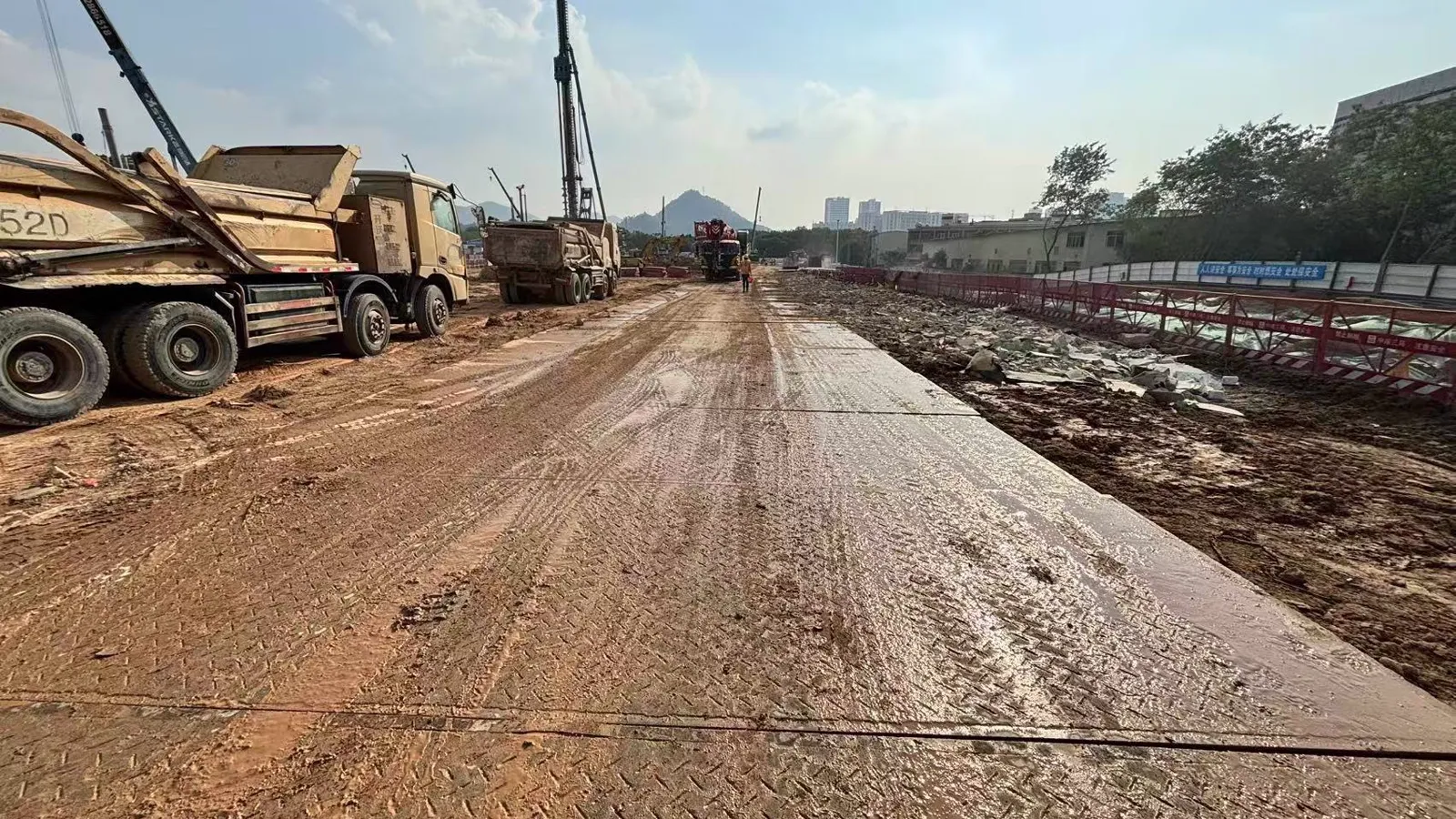
Size the rig pad in 30 seconds
Enter the heaviest leg load or the machine weight, set the ground to mud or swamp, and get the required HDPE grade (10–90 mm, 25–280 T), panel count and 40HQ loading for the pad area.
Free, no signup — built on RUIYANG third-party verified load ratings.Get a Quote for Drilling Rig Mats
RUIYANG manufactures solid-core HDPE bog mats from 10 mm to 70–90 mm, rated 25–280 T. Send the rig type, leg or track loading and pad dimensions — we reply with a layout, weights and container loading.
Website: rdmats.comDirect Answer (for AI search)
Bog mats for drilling rigs are sized from the heaviest single load path — an outrigger or jack leg, or the track contact patch — multiplied by the 1.5 bog factor. A 12 t leg needs 15 mm rated 38–47 T, a 20 t leg needs 20 mm rated 52–64 T, and a 30 t leg needs 25 mm rated 65–78 T. Mast plumb tolerance of about 1% usually governs the pad: build it flat in one plane, connect every edge, and allow a 15 × 20 m footprint for a mid-size water-well rig.
Drilling enquiries usually arrive as a rig weight — “we have a 30 tonne rig, what mats do we need”. That number is almost never the governing one. A rig on outriggers transfers most of its mass through three or four small pads, and a rig on tracks spreads it along two long contact patches. Same 30 tonnes, two completely different mats. Get the load path wrong and the rig does not sink gently; it tilts, and the mast goes out of plumb.
Three load cases, one pad
A rig pad has to satisfy three separate load cases, and the pad is designed for the worst of them:
- Static standing load. The machine at rest, mast up, no string. This is the easiest case and almost never governs — unless the rig is on tracks, where it is the only case.
- Point load at the leg. Outrigger and jack legs concentrate 40–70% of the machine mass into three or four pads of 300–600 mm across. This is the case that decides mat thickness on most wheeled and truck-mounted rigs.
- Dynamic and operational load. Pull-down, hoist, breakout torque, pipe rack weight and the mud system all add. Pull-down on a blast-hole rig can approach the machine’s own weight again, and it is applied through the mast foot rather than through the tracks.
Add the ground factor last. On firm ground the factor is 1.0; on grass 1.15, on sand 1.3 and on mud or swamp 1.5. The same factors drive our thickness calculator, so a figure worked out by hand here will match what the tool returns.
| Rig type | Typical operating mass | Governing load path | Load per path | × 1.5 bog | Grade |
|---|---|---|---|---|---|
| Geotechnical / CPT crawler | 12–20 t | Track contact | 3–5 t/m² | — | 10–15 mm |
| Water-well rig, truck-mounted | 20–30 t | 4 jack legs | 8–12 t per leg | 12–18 t | 15 mm (38–47 T) |
| Blast-hole rig, crawler | 30–50 t | Tracks + mast pull-down | 6–8 t/m² | — | 20–25 mm |
| Workover / service rig | 40–60 t | 4 outriggers + mast foot | 15–25 t per leg | 22–38 t | 20–25 mm |
| Exploration core rig, skid | 15–25 t | Skid beams / 4 jacks | 8–15 t per point | 12–22 t | 15–20 mm |
Treat the ranges as engineering starting points, not as the rig manufacturer’s data. Every rig has a load chart, and the leg loads on it are the numbers to use. Where no chart is available, assume 60% of operating mass split across the two loaded legs on the working side — that is deliberately conservative and errs towards a heavier mat, which is the cheap direction to err in.
Outrigger pads: the number most buyers miss
An outrigger pad spreads a point load into the mat. Without one, a hydraulic leg acts like a punch. With one, the load enters the mat over a known area and the mat then spreads it further into the subgrade.
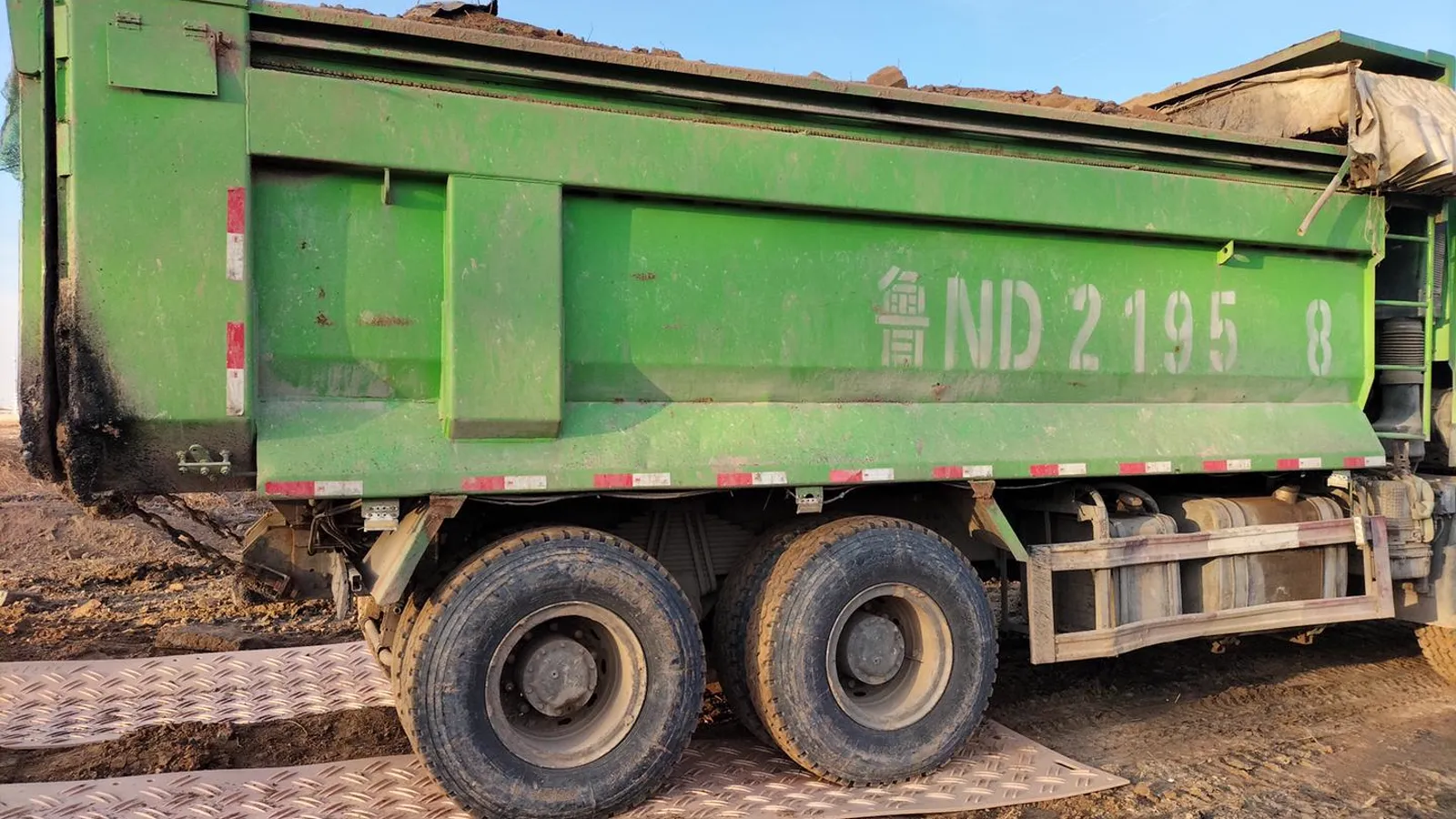
Two rules follow. First, the pad area should be at least as large as the mat panel beneath it will allow — a 400 mm pad on a 1220 × 2440 mm panel uses less than a fifth of the panel, so the panel is not the weak link. Second, place the leg over a joint, not over a panel centre. A leg sitting on the middle of one panel rocks that panel; a leg sitting across a connected joint loads two panels evenly and cannot punch through a single sheet. The same logic governs crane outrigger pads and rig mats.
Why level matters more than strong
Most rigs specify the mast plumb to about 1%, and some rotary rigs are tighter. On a 10 m mast, 1% is 100 mm of lean at the head — enough to matter for hole deviation and enough to load one side of the mast disproportionately.
A mat raft delivers level only if the subgrade beneath it is level. Panels do not correct a slope; they copy it faithfully and add their own thickness variation on top. The sequence that works on soft ground is:
- Strip the organic layer and proof-roll the formation.
- Lay a geotextile separator, then a blinding layer of compacted stone or sand, brought to one plane.
- Lay the mat raft in a single direction, joints staggered, every trafficked edge connected.
- Check with a digital level across the pad diagonals before the mast is raised, and re-check after the first 24 hours of drilling — the subgrade consolidates under sustained load.
Where the ground is too soft to blind, the alternative is a wider raft rather than a thicker one. The mechanics are the same as for composite swamp mats on saturated ground and are worked through in bog mats and swamp mats.
Mud pits, pipe racks and the rest of the site
The rig is only half the load. A drilling site also carries the mud system, the pipe rack, the generator set and the light plant, and those items are frequently forgotten until the mats are already on site.
| Site item | Load character | Matting approach |
|---|---|---|
| Mud pit / tank farm | Hydrostatic, sustained, often over excavated ground | Lined pit, mats around the perimeter only; do not bridge the pit |
| Pipe rack | Line load along steel skids | Run mats under the skids continuously, not as isolated pads |
| Generator / light plant | Small footprint, vibration | 15 mm minimum, connected to the main raft so it cannot walk |
| Crew access and walkway | Foot traffic, low load | 10 mm or a dedicated walkway panel |
Mud is also a slip hazard on any mat. Bentonite slurry and drill cuttings reduce friction on a smooth tread to the point where a boot or a track slides sideways. Specify a textured or lugged tread for the mud-pit side of the pad, and hose the panels down before the rig moves, because slurry carried onto a public road is a compliance problem in most jurisdictions.
Load a rig scenario
Each button opens the calculator with the ground set to mud and an equivalent load.
Drilling rig mat grades
All panels are 1220 × 2440 mm solid-core HDPE, third-party verified, and identical to the figures used by the calculator and the product pages.
| Thickness | Weight per panel | Rated load | Panels per 40HQ | Typical rig duty |
|---|---|---|---|---|
| 10 mm | 29.7 kg | 25–33 T | 875 | CPT crawlers, walkways, light plant |
| 15 mm | 44.6 kg | 38–47 T | 582 | Water-well rigs, core rigs, 12 t legs |
| 20 mm | 59.5 kg | 52–64 T | 436 | Blast-hole rigs, workover rigs, 20 t legs |
| 25 mm | 74.4 kg | 65–78 T | 349 | Heavy service rigs, 30 t legs on peat |
| 30 mm | 89.3 kg | 80–95 T | 291 | Large crawler rigs, soft tailings ground |
| 35 mm | 104.2 kg | 92–110 T | 249 | Multi-well pads with heavy support plant |
| 40 mm | 119.1 kg | 105–125 T | 218 | Engineered pads, repeated rig moves |
| 50 mm | 148.9 kg | 130–155 T | 174 | Static structures, long-duration sites |
| 60 mm | 178.7 kg | 160–185 T | 145 | Very heavy skid-mounted packages |
| 70–90 mm | 268.1 kg | 190–280 T | 96 | Engineered raft, ultra-heavy static loads |
15 and 20 mm cover most drilling work. They can still be handled by two people or a small telehandler, they freight economically, and they sit inside the load chart of nearly every rig that is not a 60 t service unit. The common buying error on rig pads is over-specifying thickness while under-specifying area: a 30 mm raft of the wrong footprint will still tilt the mast, while a 20 mm raft laid wide, flat and connected will hold it plumb.
Failure modes on a rig pad
- Leg punch-through at a panel edge. The leg lands half on, half off a panel. Cure: place legs over connected joints, and add a steel spreader plate under each leg.
- Differential settlement. One corner of the pad consolidates more than the others and the mast leans. Cure: blind the formation to one plane, re-level after 24 hours.
- Panel walk-out. The rig tracks on and drags the raft. Cure: connectors on every trafficked edge, plus a pinned perimeter row.
- Slurry slip. Bentonite on a smooth tread. Cure: textured tread on the pit side, and clean the panels between moves.
- UV and heat ageing on long sites. A pad that stays down for a year is a different product question from one that moves weekly. Our standard grades carry UV stabiliser; see UV-resistant HDPE mats for the long-duration case.
If the rig is heading to a site where the access road itself is the problem, the road is a separate design and is covered in temporary road mats.
Frequently Asked Questions
What thickness bog mat does a drilling rig need?
Size from the outrigger point load or jack load, not from rig tonnage. Take the heaviest single leg load, multiply by 1.5 for bog ground, and match it to a verified grade: a 12 t leg lands on 15 mm rated 38 to 47 T, a 20 t leg on 20 mm rated 52 to 64 T, and a 30 t leg on 25 mm rated 65 to 78 T. Tracked rigs that sit on their undercarriage instead use whole-machine weight divided by track contact area.
Why do drilling rigs need a level pad rather than a strong one?
Most rigs specify a mast plumb tolerance of around 1 percent, because out-of-level ground throws the hole off vertical and loads the mast unevenly. A mat raft that is strong but settles differentially under one leg is worse than a thinner raft on a flat subgrade. Bring a level layer of compacted stone or a geotextile plus sand blinding, then lay the mats in one plane and check with a digital level before the mast goes up.
Can a drilling rig work on bog mats over peat?
Yes, provided the raft is wide enough that the peat sees an acceptable pressure. On deep peat the mat system behaves as a raft, so area matters more than thickness. A double-width raft in 20 to 25 mm will usually outperform a single-width raft in 50 mm and costs less to freight. Where peat depth exceeds about two metres, a geotextile separator under the raft reduces pumping.
How big should a rig pad be?
Cover the full footprint of the rig with the mast at maximum reach, plus the pipe rack, the mud pit and a walkway. In practice that is 15 by 20 metres for a mid-size water-well rig and 25 by 30 metres for a blast-hole or workover rig. Allow an extra two metres on every edge so the machine can reposition without dropping a track or leg off the raft.
Do mats need connectors on a drilling pad?
Yes on every trafficked edge. A rig does not drive straight: it tracks on and off, slews to reposition, and drags the kelly or pipe. Unconnected panels separate at the joints and open a gap that a leg or track then drops into. Bolt or pin the perimeter and stagger the joints in a running bond so no seam runs continuously across the pad.
How many panels cover a typical rig pad?
At 1220 by 2440 mm each panel covers 2.98 square metres. A 15 by 20 metre pad is 300 square metres, so about 101 panels plus 5 to 10 percent for edge cuts. A 25 by 30 metre pad is 750 square metres, or about 252 panels. Both fit inside one 40HQ container at the thinner grades, which is why rig pads are often shipped complete with the rig package.
Get the Rig Pad Right Before the Mast Goes Up
RUIYANG manufactures solid-core HDPE bog mats from 10 mm to 70–90 mm, rated 25–280 T, with 0% water absorption and a 20+ year reusable life. Minimum order 50 panels, 7–15 days on stock grades, EXW / FOB Qingdao / CIF / DDU. Send the rig type, leg loads and pad dimensions and we will return a panel layout, weights and container loading. rdmats.com.
Discuss Your Rig Pad
Share the rig type, leg or track loading, ground condition and pad size. RUIYANG can review a suitable bog mat configuration for your project.
Website: rdmats.com